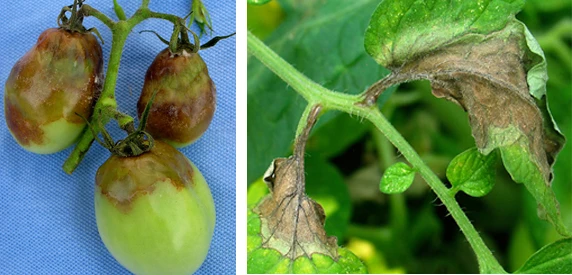
Confirmed reports of late blight in Pennsylvania and Kentucky in late May, are raising concerns that the disease could show up next in Ohio. Sally Miller, a vegetable plant pathologist with Ohio St. Univ. extension and Ohio Agricultural Research and Development Center said commercial growers and home gardeners should be looking for disease symptoms on tomato and potato plants.
“We can assume that home gardeners have planted tomatoes with late blight in Kentucky at least, and that the inoculum is not far away,” said Miller. “Therefore, we may see it sooner in Ohio than we did last year (when it was confirmed on June 25).”
Miller said the disease, which is caused by Phytophthora infestans, thrives under cool, moist conditions. Even though hot, dry weather suppresses the disease, it does not make it go away entirely.
In northwestern Pennsylvania, late blight was detected on locally grown greenhouse tomato transplants. The affected plants were destroyed and the grower adopted a fungicide spray program to manage the disease. In Kentucky, the disease was found on tomato plants at retail operations in Boone County and Lexington. The plants in both locations came from Michigan. Miller said this operation may sell tomato plants in Ohio, mainly in the Cincinnati and Columbus areas, but its sales are reported to be fairly limited in Ohio.
Pictured: Growers and home gardeners in Ohio are being advised to monitor for symptoms of late blight after the disease was found on tomato plants in Pennsylvania and Kentucky.
Photos by Meg McGrath, Cornell Univ.
Latest from Greenhouse Management
- The Growth Industry Episode 10: State of the Horticulture Industry
- Millennium Pacific Greenhouses launches California Grown Cucumber Program
- Scientists develop vitamin A-enriched tomato to fight global deficiency
- Tennessee Green Industry Field Day scheduled for June 11
- UTIA and UT Knoxville research teams will develop automated compost monitoring system
- Ken and Deena Altman receive American Floral Endowment Ambassador Award
- [SNEAK PEEK] Leading Women of Horticulture: The women of Fairview Greenhouses & Garden Center
- [SNEAK PEEK] Leading Women of Horticulture: The inventive women of TPIE ’26