Every venture comes with its share of risks. All the preparation and wise management in the world may not be enough to prevent every possible mishap.
This is what makes it all the more important to practice diligent and thorough risk management in all sectors of a business. Nursery stock growers, greenhouse managers and retail garden center owners understand the benefit of insuring their properties and products, but proactively mitigating risks before they can arise demands a more broad and thoughtful approach, says John Hodapp, senior vice president of agency operations with Hortica®, a brand of the Sentry Insurance Group.
“A lot of people would equate risk management to insurance, perhaps loss prevention,” Hodapp says. “Risk management is broader than that. Risk management is really a process a risk manager would take to identify, assess and prioritize risks, and then take steps to treat those risks. Insurance is one of those tools that can be used to treat risks but it’s not the only tool.”
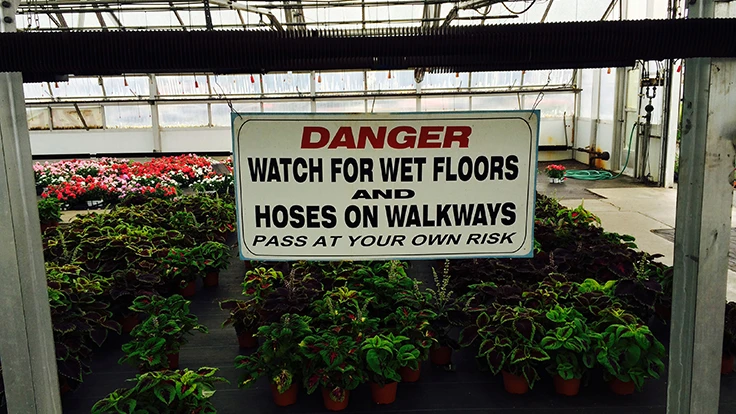
At many small-to-medium-sized businesses, risk management takes the form of managers and owners carefully reviewing daily practices and conditions around the store or facility to ensure employees and/or customers are safe and operations are continuing efficiently.
“Most of our customers don’t have a dedicated risk manager, but they have someone assigned to safety – it could be a full-time individual or it could be part of another employee’s job,” Hodapp says. “Typically, that responsibility would be handled by the chief financial officer.”
Risk management intertwines itself into financial, personnel and operational decisions in several ways. Although specific challenges can depend on the industry a business is involved in, Hodapp says the goal remains the same: continuity of the company.
“In terms of risk management, we typically think about what needs to be done to preserve and protect the business,” Hodapp says. “Many of these businesses are family businesses, and they’d like to see future generations [take over], so our main priority is to take steps to protect the viability and futures of those businesses.”
Anyone involved in growing and selling plant goods knows that weather is notorious for being an uncontrollable and, at times, an unpredictable factor that can lead to loss of inventory or productivity. Hodapp says cold snaps and other inclement weather events are among the factors that can be insured against with the right precautions.

Planning ahead for cold snaps and other inclement weather can help greenhouse managers prevent product loss.
Effective risk management involves examining the possible consequences of issues such as inclement weather and equipment failure and implementing ways to minimize the impact, if not prevent the risk entirely, Hodapp says.
“Our process includes identifying risks and then determining how best to treat them,” He says. “Ways to treat those risks include avoidance. You can’t avoid the risk of having a crop freeze, but you can take steps to reduce the frequency and also severity of those losses. Steps like having a backup generator, so that if the power goes out, there’s a backup source of electricity to run the heating systems, or having redundant heating systems.”
No matter what steps a business takes to minimize risks and ensure continuity, there can be no lasting success without the entire company being involved and engaged in the risk management process, Hodapp says.
“It’s really important, no matter the topic, keeping safety in the forefront of those employees’ minds. And that needs to start from the top. It’s critical that the senior management and ownership of these firms buy into this concept because it’s hard to walk the walk if the bosses aren’t clearly behind the efforts to promote a safer workplace.”
Top photo courtesy of Hortica; Inline photo: Kelli Rodda
Latest from Greenhouse Management
- The Growth Industry Episode 10: State of the Horticulture Industry
- Millennium Pacific Greenhouses launches California Grown Cucumber Program
- Scientists develop vitamin A-enriched tomato to fight global deficiency
- Tennessee Green Industry Field Day scheduled for June 11
- UTIA and UT Knoxville research teams will develop automated compost monitoring system
- Ken and Deena Altman receive American Floral Endowment Ambassador Award
- [SNEAK PEEK] Leading Women of Horticulture: The women of Fairview Greenhouses & Garden Center
- [SNEAK PEEK] Leading Women of Horticulture: The inventive women of TPIE ’26