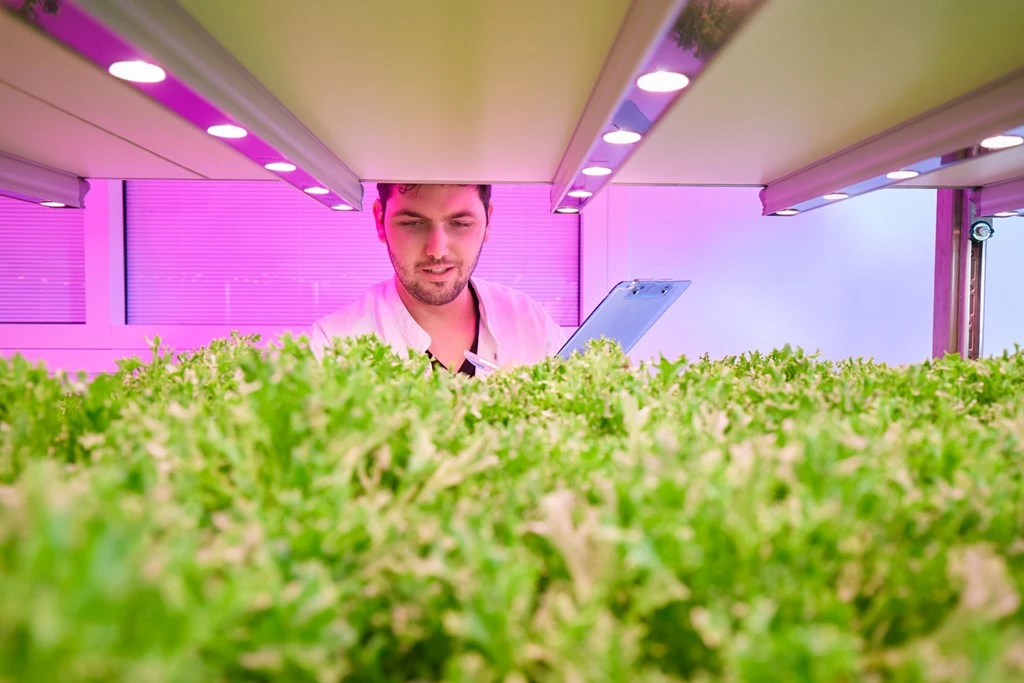
Philips Lighting Research along with HAS School for Agriculture and Wageningen University in the Netherlands recently carried out three simultaneous trials and discovered nitrate levels in the plants could be decreased or increased.
The trials were carried out at the same time in winter, one in a greenhouse with HID toplighting, one in a greenhouse with LED toplighting, and one in a city farm (closed-environment) with LED lighting. The exact same crops of lettuce and the same fertilizer were used in all three trials. The crops in the city farm had significantly lower levels of nitrates because they were grown consistently with the right amount of light every day.

Read the two-part series on how LED grow lights can influence nitrate levels in leafy greens
The crops grown in the greenhouse under HID and LED both had higher levels of nitrate because they were affected by different climate conditions and less light levels than optimum. The plants experienced cloudy, sunny, colder and warmer days, during which nitrates accumulated in the leaves of the plants. The results of this experiment confirmed that in addition to LED lighting, climate is an important parameter to control to maximize nitrate reduction.
This research shows that the type of lighting and the growing environment can have a significant impact on the nitrate levels in leafy greens. Growers in both city farms and greenhouses can use this information to open new opportunities.
Philips Lighting is now Signify

Latest from Greenhouse Management
- Jackson & Perkins expands into Canadian market
- Green & Growin’ 26 brings together North Carolina’s green industry for education, connection and growth
- Marion Ag Service announces return of Doug Grott as chief operating officer
- Cincinnati Zoo & Botanical Garden debuting new perennial section at 2026 Breeder Showcase
- The Garden Conservancy hosting Open Days 2026
- Registration open for 2026 Perennial Plant Association National Symposium
- Resource Innovation Institute and North Dakota State University explore co-location of data center and greenhouses
- Fred C. Gloeckner Foundation Research Fund calls for 2026 research proposals