As activities start to pick up around the greenhouse with spring production, don’t forget to inspect incoming plant material for incoming insects (aphids or thrips), as well as foliar and root diseases. Tapping incoming plants over a sheet of white paper is a quick and easy way to look for aphids, thrips and even spider mites.
Univ. of Mass. extension floriculture specialist Tina Smith and Univ. of Conn. extension horticulture and greenhouse IPM specialist said it is very easy for growers to overlook just a few aphid nymphs that can quickly result in an aphid outbreak.
Green peach aphids blend in with the plants and signs of aphid activity are often seen before the actual aphids. Green peach aphids are typically located on the terminal growth.
Melon aphids tend to be located in the plant interior and be in groups on the stems and flower buds.
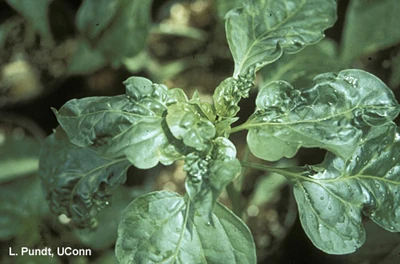
Foxglove aphids are often found on the lower leaves and may drop off of the plant. Foxglove aphids also tend to cause more foliar distortion than other types of aphids. Look for shed white skins, shiny honeydew, the presence of ants, curled new leaves and distorted growth. Smith and Pundt said the key is to find the hot spots early and treat. Monitor plants weekly for aphids. Rely on plant inspection, not sticky cards. If winged aphids are showing up on sticky cards, there is already a hot spot of activity somewhere in the greenhouse.
Pictured: Leaf distortion on pepper caused by foxglove aphid.
Photo by Leanne Pundt, Univ. of Conn.