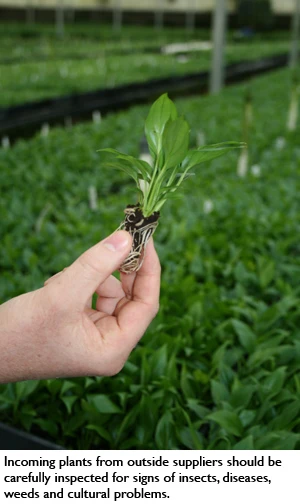
All incoming plants from outside suppliers should be carefully inspected for signs of insects, diseases, weeds and cultural problems. Univ. of Mass. extension floriculture specialist Tina Smith said the entire plant (leaves, stems and roots) should be inspected for signs of pest activity and for general health. Check incoming plugs and transplants for any distorted new growth that might be caused by thrips. Blackened, firm stems and leaf spots on regular impatiens and New Guinea impatiens are signs of impatiens necrotic spot virus. INSV test kits can provide a quick confirmation of suspicious looking plants.
Spider mites are usually located on the undersides of leaves. They are often found along the mid-vein of ivy geraniums, ipomea, thunbergia and other susceptible plants.
Roots that are brown or decayed are evidence of root rot disease or may be caused by overwatering or high soluble salts.
When handling incoming plants, work in blocks and wash hands thoroughly between inspecting each block. If disposable gloves are worn, change or clean them between blocks. This will prevent the spread of infectious diseases that are transmitted mechanically, such as bacterial leaf spot on geraniums and tobacco mosaic virus on petunias and related crops.
Latest from Greenhouse Management
- The Growth Industry Episode 10: State of the Horticulture Industry
- Millennium Pacific Greenhouses launches California Grown Cucumber Program
- Scientists develop vitamin A-enriched tomato to fight global deficiency
- Tennessee Green Industry Field Day scheduled for June 11
- UTIA and UT Knoxville research teams will develop automated compost monitoring system
- Ken and Deena Altman receive American Floral Endowment Ambassador Award
- [SNEAK PEEK] Leading Women of Horticulture: The women of Fairview Greenhouses & Garden Center
- [SNEAK PEEK] Leading Women of Horticulture: The inventive women of TPIE ’26