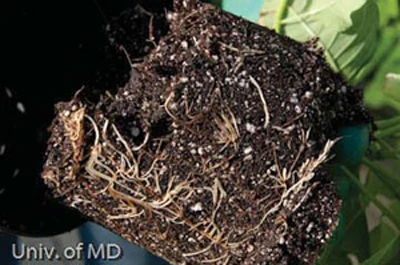
Univ. of Md. extension personnel advise poinsettia growers to look for foliar chlorosis on plants. They should then inspect the roots to see if there is any discoloration that could indicate root diseases problems such as Pythium. Roots infected with Pythium turn brown and the root sloughs off at the tip leaving a fine strand. To avoid root rot problems be sure to allow the growing medium to dry out between watering. Fungicide options include FenStop, Banol, Banrot, Truban or Terrazole and Subdue Maxx. Rotate products with different active ingredients to avoid resistance in Pythium populations. Some Pythium strains may be insensitive to Subdue Maxx.
Proper spacing of poinsettias can help minimize foliar disease problems. Use horizontal airflow fans to circulate the air around the plants. Leaves on plants infected with Botrytis (gray mold) should be removed and bagged to get the fungal spores out of the greenhouse. Fungicides should be applied cautiously to poinsettias with bracts to avoid phytotoxicity problems.
Growers should also continue to monitor for whiteflies.
Pictured: Pythium on poinsettia roots.
Photo courtesy of Univ. of Md.
Latest from Greenhouse Management
- The Growth Industry Episode 10: State of the Horticulture Industry
- Millennium Pacific Greenhouses launches California Grown Cucumber Program
- Scientists develop vitamin A-enriched tomato to fight global deficiency
- Tennessee Green Industry Field Day scheduled for June 11
- UTIA and UT Knoxville research teams will develop automated compost monitoring system
- Ken and Deena Altman receive American Floral Endowment Ambassador Award
- [SNEAK PEEK] Leading Women of Horticulture: The women of Fairview Greenhouses & Garden Center
- [SNEAK PEEK] Leading Women of Horticulture: The inventive women of TPIE ’26