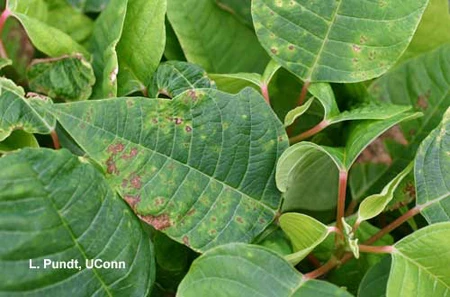
Poinsettia growers are being advised to look for symptoms of bacterial leaf spot. Caused by Xanthomonas campestris pv. poinsettiicola, the disease primarily affects plants in propagation, but may persist to impact later production stages. Symptoms begin with small, dull gray water-soaked areas on the leaves. Small, angular tan spots with a surrounding yellow halo develop and then turn brown eventually coalescing. Univ. of Conn. extension horticulture and greenhouse IPM specialist Leanne Pundt and Cornell Univ. plant pathologist Margery Daughtrey suggest that plant samples be sent to a diagnostic lab to confirm exact cause.
High humidity and temperature levels along with close plant spacing favor rapid disease development and spread. Avoid splashing water between plants and keep the foliage as dry as possible. Infected plants should be discarded and leaf wetness should be kept to a minimum. Application of copper bactericides can help to reduce disease spread. Bacillus subtilis also provides some biological control of leaf-spotting bacteria.
Pictured: Bacterial leaf spot usually impacts poinsettia in propagation, but can persist to affect later production stages.
Photo by Leanne Pundt, Univ. of Conn.