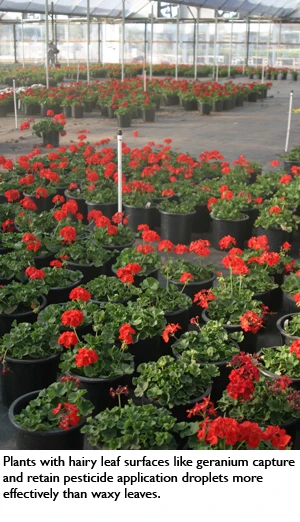
Whether the leaf surface of a plant is hairy or waxy has a major impact on effectiveness of foliar pesticide applications. Ohio St. Univ. researchers are studying the impact of liquid pesticide applications on waxy and hairy geranium leaves. Hairy leaves captured and retained droplets more effectively than waxy leaves. Droplets on hairy leaves covered more surface area as they evaporated and spread over the leaf more quickly, increasing plant uptake of the pesticide by 50%.
“Foliar uptake efficiency is affected by chemistry of the product applied, target surface characteristics, droplet size, evaporation time and how much the surface area is wetted,” said extension agricultural engineer Erdal Ozkan.
The hairs on leaves protect the droplets from rebounding and drifting and allow the droplets to spread out over a larger contact area.
Researchers also found that adding a surfactant to the pesticide solution that droplets cling better and are taken up by the plant much more readily.
Ozkan said the chemical companies can use the findings to recommend specific pesticide rates and application methods for specific target surfaces to achieve maximum product benefit. The researchers are still trying to determine why droplets sitting on the middle of the leaf surface behave differently than those located along the leaf veins or leaf stems.
Latest from Greenhouse Management
- Jackson & Perkins expands into Canadian market
- Green & Growin’ 26 brings together North Carolina’s green industry for education, connection and growth
- Marion Ag Service announces return of Doug Grott as chief operating officer
- Cincinnati Zoo & Botanical Garden debuting new perennial section at 2026 Breeder Showcase
- The Garden Conservancy hosting Open Days 2026
- Registration open for 2026 Perennial Plant Association National Symposium
- Resource Innovation Institute and North Dakota State University explore co-location of data center and greenhouses
- Fred C. Gloeckner Foundation Research Fund calls for 2026 research proposals