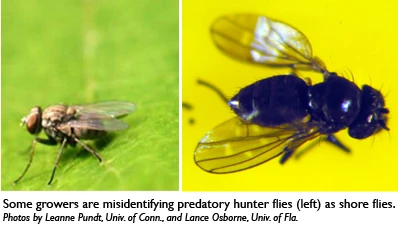
Hunter flies (Coenosia attenuata) are being found more often on sticky cards in greenhouses. This grayish, predatory fly is similar in appearance, but smaller, than the common housefly. Leanne Pundt, Univ. of Conn. extension horticulture and greenhouse IPM specialist, and Tina Smith, Univ. of Mass. extension floriculture specialist, said some growers confuse hunter flies with shore flies.
Adult shoreflies, which are smaller than hunter flies, have short robust bodies, short legs and short antennae. Hunter flies are darker in color and have 5 clear spots on their wings.
Adult hunter flies prey on other flying insects, including fungus gnats, shore flies, leafminer adults and, to a lesser extent, whiteflies. They catch their prey in flight.
Hunter fly larvae live in the soil and are predators of soil-dwelling organisms including fungus gnat and shore fly larvae. Larvae grow for about two weeks and then pupate in the soil for two weeks.
Latest from Greenhouse Management
- The Growth Industry Episode 9: IPPS International Tour preview with Brie Arthur and Liz Erickson
- Help us honor the industry's best
- University of Florida study unlocks secrets of invasive short-spined thrips
- Leaders of the future
- American Floral Endowment announces 2026 Grow Pro Webinar Series lineup
- Mondi Products launches Avara Technology
- IUNU and Priva partner on yield forecasting for greenhouse growers
- Sakata Seed America announces new CEO and a promotion