Some greenhouse fruit and vegetable producers will soon be able to grow their produce more quickly and less expensively thanks to research into LED lighting conducted at McGill Univ. in Ste-Anne-de-Bellevue, Québec, Canada.
The Government of Canada and GE Canada have each invested $1.3 million in a research project with Les Serres St-Laurent (Savoura) and McGill Univ. to develop LED (light emitting diode) lighting technology for commercial greenhouses. The anticipated benefits may include reduced energy consumption and year-round production and increased crop quality and yield.
Savoura, one of the world’s largest greenhouse tomato growers under supplemental lighting, will receive trial testing of GE’s LED lighting fixtures to help increase energy efficiency and lower production costs.
Mark Lefsrud, an assistant professor in McGill Univ.’s Department of Bioresource Engineering, said greenhouse energy savings should be in the 25-40% range, with a possibility of 50% as the efficiency of the LEDs continues to improve.
“The heat load of the LEDs is almost none existent. You can put the plant right up next to it,” Lefsrud said. “With standard lights you have to keep them at least three feet away or you’ll start burning the plants.”
Lefsrud and his research team are also conducting tests on lettuce and petunias. The long-term goal is to one day grow just about anything indoors under artificial lighting.
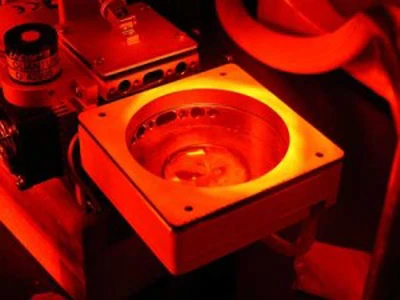
Pictured: A tomato seedling exposed to LED lighting.
Photo by Mark Lefsrud, McGill Univ.
Latest from Greenhouse Management
- The Growth Industry Episode 10: State of the Horticulture Industry
- Millennium Pacific Greenhouses launches California Grown Cucumber Program
- Scientists develop vitamin A-enriched tomato to fight global deficiency
- Tennessee Green Industry Field Day scheduled for June 11
- UTIA and UT Knoxville research teams will develop automated compost monitoring system
- Ken and Deena Altman receive American Floral Endowment Ambassador Award
- [SNEAK PEEK] Leading Women of Horticulture: The women of Fairview Greenhouses & Garden Center
- [SNEAK PEEK] Leading Women of Horticulture: The inventive women of TPIE ’26