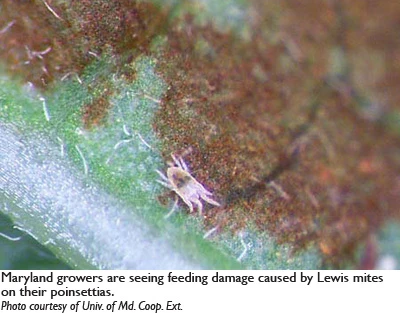
Univ. of Md. Coop. Ext. specialists first began finding Lewis mites on poinsettias in 1996. This year they are receiving plant samples with foliage damage caused by the mites. The mites are found primarily on the undersides of leaves. They have a similar color as two-spotted spider mites, but Lewis mites are smaller and narrower with several small, greenish spots. Feeding symptoms are subtle so early detection of a Lewis mite infestation is difficult. Feeding appears as faint flecking or stippling of the foliage, which causes a chlorotic appearance as plants mature. As populations increase, the upper leaves begin to turn brown. The mites form webbing around the growing tips on which they gather and seek to gain altitude in order to be blown or move to new feeding areas. Controls that extension personnel have found to be effective include Floramite, Sanmite, Akari, Judo, Pylon and Avid.
Latest from Greenhouse Management
- The Growth Industry Episode 10: State of the Horticulture Industry
- Millennium Pacific Greenhouses launches California Grown Cucumber Program
- Scientists develop vitamin A-enriched tomato to fight global deficiency
- Tennessee Green Industry Field Day scheduled for June 11
- UTIA and UT Knoxville research teams will develop automated compost monitoring system
- Ken and Deena Altman receive American Floral Endowment Ambassador Award
- [SNEAK PEEK] Leading Women of Horticulture: The women of Fairview Greenhouses & Garden Center
- [SNEAK PEEK] Leading Women of Horticulture: The inventive women of TPIE ’26