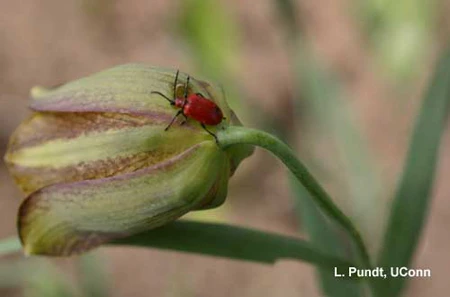
Lily leaf beetle adults and larvae have been reported to be active, feeding on the foliage of Asiatic lilies and Fritillaria in areas of the Northeast. Lilioceris lilii lays its eggs and develops only on Lilium species (not daylilies) and Fritillaria species. It can be a devastating pest on true lilies.
Univ. of Mass. floriculture extension specialist Tina Smith and Univ. of Conn. extension horticulture and greenhouse IPM specialist Leanne Pundt advise growers to monitor for the bright red beetles and also for the eggs on the undersides of the foliage. Growers should inspect the leaves for fine tan-colored, irregular-shaped rows of eggs about 1 inch long. Just before hatching, these eggs turn a bright red color. When found, the eggs can be removed and destroyed.
Occasionally lily leaf beetle feeds on lily of the valley (Convallaria majalis), hollyhock (Alcea), various hosta species, soloman's seal (Polygonatum sp.), bittersweet (Solanum sp.) and potato (Solanum tuberosum).
Pictured: Growers are being advised to look for increased activity of lily leaf beetle on lily species plants.
Photo by Leanne Pundt, Univ. of Conn.
Latest from Greenhouse Management
- Millennium Pacific Greenhouses launches California Grown Cucumber Program
- Scientists develop vitamin A-enriched tomato to fight global deficiency
- Tennessee Green Industry Field Day scheduled for June 11
- UTIA and UT Knoxville research teams will develop automated compost monitoring system
- Ken and Deena Altman receive American Floral Endowment Ambassador Award
- [SNEAK PEEK] Leading Women of Horticulture: The women of Fairview Greenhouses & Garden Center
- [SNEAK PEEK] Leading Women of Horticulture: The inventive women of TPIE ’26
- Growing successful spring crops with Topflor