Bacterial leaf spot of begonia is caused by Xanthomonas axonopodis pv. begonia (formerly known as X. campestris pv. begonia). Plant pathologist Jan Byrne at Mich. St. Univ. Diagnostic Services said the disease is frequently spread via contaminated plant material. She advises growers to inspect incoming begonias for signs of disease. Plants with any suspicious symptoms should be tested at a diagnostic lab before they are put in close proximity to other begonias.
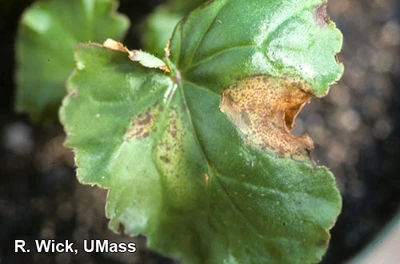
Symptoms include water-soaked foliar lesions and wilting. The lesions are especially visible from the underside of the foliage. Severely affected leaves may fall off the plant. The bacterium can become systemic colonizing the plants’ vascular tissues causing wilting symptoms.
The bacteria can be spread when irrigation water splashes from an infected plant to the foliage of nearby hosts. Overhead irrigation should be carefully timed to minimize the amount of time that the foliage remains wet. Longer durations of leaf wetness can promote further disease spread.
The bacterium can also be spread mechanically from plant to plant. Greenhouse staff can readily spread the bacterium by handling plants during pruning of blossoms, removing dead leaves, etc. While some handling may be required periodically throughout production, be sure to avoid handling the plant material when the foliage is wet. Frequent hand washing should be encouraged when working with susceptible begonias.
Bacterial leaf spot on begonia is caused by a Xanthomonas that can only infect plants in the genus Begonia. It is a different pathovar of Xanthomonas than the one that infect geraniums (X. axonopodis pv. Pelargonii), that causes bacterial wilt of geranium. There are many different types of begonias, most of which can be affected, although they vary somewhat in susceptibility. The diagnostic test kits for the Xanthomonas on gernium cannot be used to detect the Xanthomonas on begonia.
Pictured: Bacterial leaf spot on begonia
Photo by Rob Wick, Univ. of Mass.
Latest from Greenhouse Management
- The Growth Industry Episode 10: State of the Horticulture Industry
- Millennium Pacific Greenhouses launches California Grown Cucumber Program
- Scientists develop vitamin A-enriched tomato to fight global deficiency
- Tennessee Green Industry Field Day scheduled for June 11
- UTIA and UT Knoxville research teams will develop automated compost monitoring system
- Ken and Deena Altman receive American Floral Endowment Ambassador Award
- [SNEAK PEEK] Leading Women of Horticulture: The women of Fairview Greenhouses & Garden Center
- [SNEAK PEEK] Leading Women of Horticulture: The inventive women of TPIE ’26