One of the biggest issues with mealybugs is the fact that they’re difficult to spot, says Raymond Cloyd, entomologist at Kansas State University. These pests enjoy feeding on coleus, especially, but also a wide variety of annuals, perennials, including succulents.
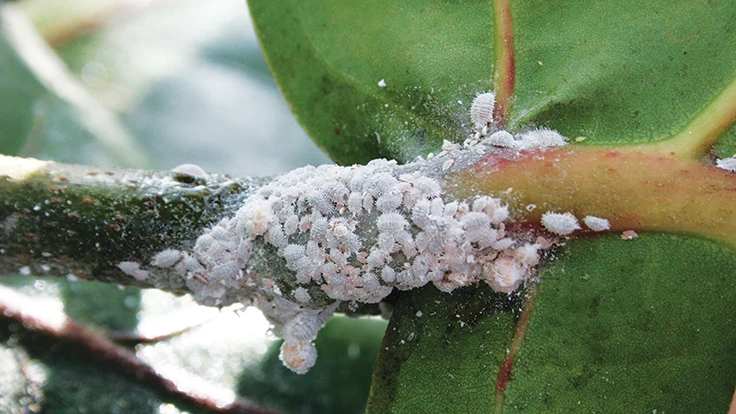
Mealybugs begin as orange-yellowish crawlers, but as they mature, they develop a waxy coating and become white, Cloyd says. “They’re kind of elliptical,” he adds. “[And] you’ll see fringes on the outer edge of the body.”
What’s more, mealybugs clump together in an act called “spatial distribution,” where they’ll congregate to feed on specific, inaccessible areas of the plant, like stems and undersides of leaves. They’re also difficult to scout because yellow sticky cards won’t work, so visual scouting is key. “That’s why I call mealybugs a sneaky pest, because they’ll creep up on you,” Cloyd says.
But once mealybugs are spotted together on your plant, Cloyd says it’s almost too late. Therefore, if you see a large presence, cutting your losses is likely the best plan of action.
“When you have these plants that are so heavily infested, just throw them away. You’re never going to rescue them,” Cloyd says. “Also, you want to throw the plants out that are about 1 foot away around it because even though you don’t see them, they’ve probably got mealybugs.”
However, being proactive by using prophylactic sprays early in the season can prevent populations from building up, he adds. And if you happen to catch mealybugs very early on – before the crawlers are active -- insect growth regulators do have a chance in suppressing them, Cloyd says. And when you are spraying after spotting them, Cloyd recommends to remember these steps.
“I call it ‘The Big Three,’” he says. “Timing of application, which is when their colors are present; coverage of all plant parts. This is key, because of where they’re located; and then frequency of application. You have to make applications probably once a week. If you wait longer, then you’ll get generations, or you’ll miss the generations.”
Photo: Raymond Cloyd
Latest from Greenhouse Management
- The Growth Industry Episode 10: State of the Horticulture Industry
- Millennium Pacific Greenhouses launches California Grown Cucumber Program
- Scientists develop vitamin A-enriched tomato to fight global deficiency
- Tennessee Green Industry Field Day scheduled for June 11
- UTIA and UT Knoxville research teams will develop automated compost monitoring system
- Ken and Deena Altman receive American Floral Endowment Ambassador Award
- [SNEAK PEEK] Leading Women of Horticulture: The women of Fairview Greenhouses & Garden Center
- [SNEAK PEEK] Leading Women of Horticulture: The inventive women of TPIE ’26