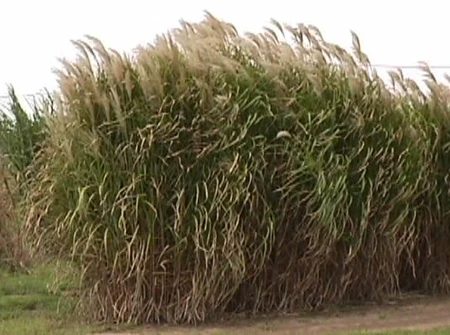
Giant miscanthus (Miscanthus x giganteus), a perennial warm-season grass from Asia, is being considered for its high biomass output and its adaptability to many different soil types. Researchers at Ohio St. University’s South Centers at Piketon are studying the feasibility of growing the plant across southern Ohio for combustion and conversion to ethanol.
Maurus Brown, an OSU Extension bioenergy and specialty crop specialist, is collaborating with Mendel Biotechnology on a 5-year trial. About an acre of land on the OSU South Centers campus will be used to produce unfertilized miscanthus.
Giant miscanthus varieties are seed-sterile and propagated by rhizome division or plugs. Although this could mean high input costs for initial establishment, the investment could be amortized over many years due to a long crop rotation. Once established, the plant has a stand life of as much as 15 years. Since it is a perennial there’s no need to re-plant each year.
According to the Iowa St. University publication ”Miscanthus Hybrids for Biomass Production,” the planting rate is about 4,000 plants per acre, but commercial planting rates will be ultimately determined by the economics that work best for the grower and the end user.
Another reason for the interest in giant miscanthus is it’s considered more productive than other biofuel crops, such as switchgrass. University of Illinois research found that miscanthus can produce twice the biomass as switchgrass.
Pictured: Giant miscanthus (Miscanthus x giganteus) is being studied for its potential use as a biofuel and for conversion to ethanol.
Photo courtesy of Miss. St. Univ.
Latest from Greenhouse Management
- The Growth Industry Episode 10: State of the Horticulture Industry
- Millennium Pacific Greenhouses launches California Grown Cucumber Program
- Scientists develop vitamin A-enriched tomato to fight global deficiency
- Tennessee Green Industry Field Day scheduled for June 11
- UTIA and UT Knoxville research teams will develop automated compost monitoring system
- Ken and Deena Altman receive American Floral Endowment Ambassador Award
- [SNEAK PEEK] Leading Women of Horticulture: The women of Fairview Greenhouses & Garden Center
- [SNEAK PEEK] Leading Women of Horticulture: The inventive women of TPIE ’26