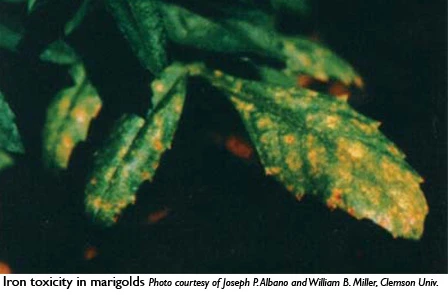
The availability of iron and manganese to plants depends on the growing medium pH. These 2 micronutrients are most readily available in lower pH ranges. Their availability is also affected by the presence of other nutrients.
Univ. of Md. commercial horticulture agent and regional extension specialist Andrew Ristvey said the 2 nutrients are antagonistic with each other with the higher concentration of one resulting in less availability of the other.
Ristvey said some ornamental plants, including alyssum, basil, geranium, gerbera, impatiens, larkspur, some marigolds, phlox, salvia and tomato are very efficient at taking up iron. They secrete acids from their roots which lower the substrate pH making iron available for uptake. When growing these plants in organic substrates Ristvey tells growers to monitor the substrate pH and to maintain it above 5.8 in order to limit iron availability.
High iron concentrations may first create manganese deficiency because of the antagonistic interaction between the 2 nutrients. Manganese deficiency looks similar to iron deficiency initially, but manganese deficiency can appear on both new and older leaves, even though it is relatively immobile in the plant. Ristvey said implementing a substrate monitoring program, checking medium pH and electrical conductivity during the production cycle and keeping good records should help to avoid deficiency and toxicity problems.
Latest from Greenhouse Management
- Jackson & Perkins expands into Canadian market
- Green & Growin’ 26 brings together North Carolina’s green industry for education, connection and growth
- Marion Ag Service announces return of Doug Grott as chief operating officer
- Cincinnati Zoo & Botanical Garden debuting new perennial section at 2026 Breeder Showcase
- The Garden Conservancy hosting Open Days 2026
- Registration open for 2026 Perennial Plant Association National Symposium
- Resource Innovation Institute and North Dakota State University explore co-location of data center and greenhouses
- Fred C. Gloeckner Foundation Research Fund calls for 2026 research proposals