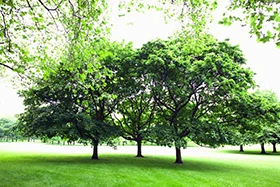
.jpg) T© 2004 JupiterImages. All Rights Reserved.rees and green spaces offer more than just aesthetics. Exposure to plants provides a variety of physical and mental benefits for people including lower anxiety, lower blood pressure, stress relief, better concentration and increased overall happiness. It’s an impressive list of benefits that is backed by science. We take a closer look at some of those studies, including one by the U.S. Forest Service released in January.
T© 2004 JupiterImages. All Rights Reserved.rees and green spaces offer more than just aesthetics. Exposure to plants provides a variety of physical and mental benefits for people including lower anxiety, lower blood pressure, stress relief, better concentration and increased overall happiness. It’s an impressive list of benefits that is backed by science. We take a closer look at some of those studies, including one by the U.S. Forest Service released in January.
But are people really getting the message? Dive into the research yourself, then share it with your employees and your customers, as well as your local and national lawmakers.
Trees and human mortality
Evidence is increasing from multiple scientific fields that exposure to the natural environment can improve human health. In a new study by the U.S. Forest Service, the presence of trees was associated with human health.
For Geoffrey Donovan, a research forester at the Forest Service’s Pacific Northwest Research Station, and his colleagues, the loss of 100 million trees in the Eastern and Midwestern United States was an unprecedented opportunity to study the impact of a major change in the natural environment on human health.
In an analysis of 18 years of data from 1,296 counties in 15 states, researchers found that Americans living in areas infested by the emerald ash borer, a beetle that kills ash trees, suffered from an additional 15,000 deaths from cardiovascular disease and 6,000 more deaths from lower respiratory disease when compared to uninfected areas. When emerald ash borer comes into a community, city streets lined with ash trees become treeless.
The researchers analyzed demographic, human mortality and forest health data at the county level between 1990 and 2007. The data came from counties in states with at least one confirmed case of the emerald ash borer in 2010. The findings—which hold true after accounting for the influence of demographic differences, like income, race and education—are published in the current issue of the American Journal of Preventive Medicine.
“There’s a natural tendency to see our findings and conclude that, surely, the higher mortality rates are because of some confounding variable, like income or education, and not the loss of trees,” said Donovan. “But we saw the same pattern repeated over and over in counties with very different demographic makeups.”
After accounting for demographic differences, the increased mortality rates were highest in wealthier counties, indicating that higher-income areas face the most potential harm from the spread of the emerald ash borer. This could be because wealthy areas have more trees to begin with and provide safer havens for people to enjoy the benefits of public outdoor space.
Although the study shows the association between loss of trees and human mortality from cardiovascular and lower respiratory disease, it did not prove a causal link. The reason for the association is yet to be determined. But past research has shown that trees can improve air quality and reduce stress, and both air quality and stress have been linked to cardiovascular and respiratory disease.
The emerald ash borer was first discovered near Detroit, Mich., in 2002. The borer attacks all 22 species of North American ash and kills virtually all of the trees it infests.
This research highlights the important contribution trees make to community health, Donovan said. In addition, results support programs to prevent the introduction and spread of invasive forest pests.
The goal of this study was to measure the impact of tree loss on cardiovascular and lower-respiratory mortality rates, he said.
Growers need to share this information with customers and lawmakers. And that’s what Nancy Buley, director of communications at J. Frank Schmidt & Son Co. in Oregon, has already done. She forwarded this study to Oregon’s senators and representatives to remind them of how important it is to support urban forestry via reauthorization of the Farm Bill. She also plans to share this kind of information with landscape architects and urban foresters.
“We share this information with our customers who sell trees to consumers, and hope they are using it in their marketing efforts,” Buley said. “People do want to live a greener, more sustainable lifestyle, and this kind of information certainly makes a good argument as to why they should plant trees to improve their personal garden environment as well as contributing to the overall health of their community.
“U.S. Forest Service research that quantifies the value of trees and our urban forests is invaluable information that we growers should be using to market our trees. Geoff Donovan’s most recent study draws a clear relationship between trees and human health, and one that we can leverage into more tree sales.”
The study was conducted in collaboration with David Butry, with the National Institute of Standards and Technology; Yvonne Michael, with Drexel University; and Jeffrey Prestemon, Andrew Liebhold, Demetrios Gatziolis and Megan Mao, with the Forest Service’s Southern, Northern and Pacific Northwest Research Stations.
For more: www.fs.fed.us/pnw; gdonovan@fs.fed.us
READ MORE ABOUT THE HEALTH BENEFITS OF NATURE HERE