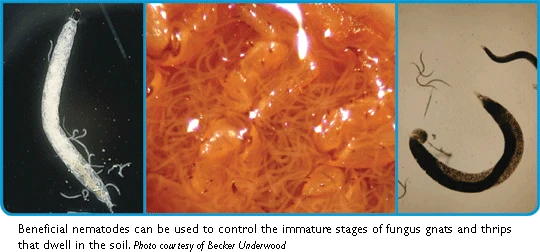
Steinernema feltiae, an entomopathogenic nematode, is primarily used against fungus gnat larvae and thrips pupae in the soil. Fungus gnat larvae may be parasitized in any larval stage. Leanne Pundt, Univ. of Conn. extension horticulture and greenhouse IPM specialist, said nematodes have traditionally been used against soil dwelling pests because they are sensitive to ultra violet light.
The nematodes enter the insect host through body openings. They multiply within the host and release a symbiotic bacterium whose toxin kills the fungus gnats. The larvae die within 1-2 days. More than one generation of nematodes may develop in a dead host insect in the medium. The infective juveniles then exit the dead body and search for new hosts to infect
The nematode S. feltiae is sold under the trade names of NemaShield and Nemasys. Both of these products are labeled as a soil drench treatment against fungus gnat larvae.
Unlike many traditional pesticides there is no REI (an added bonus in propagation houses), nor possibility that the target pest will develop resistance. No adverse effects have been shown against non-target organisms in many different field studies.
Pundt said nematodes are compatible with a number of different pesticides. However, they are generally not compatible with organophosphates, carbamates, and nematicides.
Latest from Greenhouse Management
- Jackson & Perkins expands into Canadian market
- Green & Growin’ 26 brings together North Carolina’s green industry for education, connection and growth
- Marion Ag Service announces return of Doug Grott as chief operating officer
- Cincinnati Zoo & Botanical Garden debuting new perennial section at 2026 Breeder Showcase
- The Garden Conservancy hosting Open Days 2026
- Registration open for 2026 Perennial Plant Association National Symposium
- Resource Innovation Institute and North Dakota State University explore co-location of data center and greenhouses
- Fred C. Gloeckner Foundation Research Fund calls for 2026 research proposals