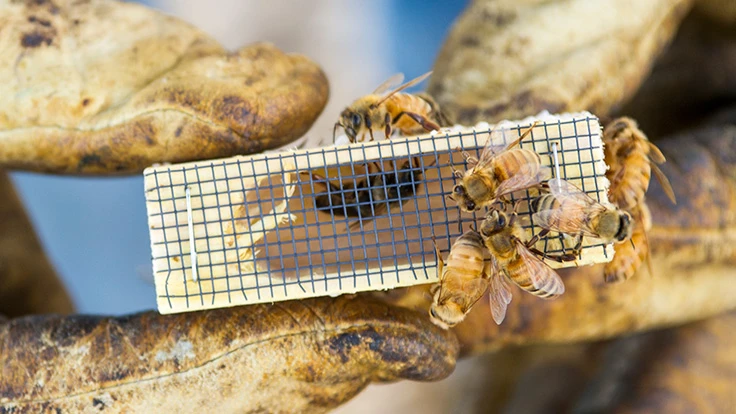
A queen bee is kept in a seperate box until she and the workers are added to the new colony. MSU photo by Kelly Gorham.
By Marshall Swearingen for the MSU News Service
BOZEMAN, Mont. -- The Honey Bee Research Site and Pollinator Garden at Montana State University's Horticulture Farm is buzzing with six new honey bee colonies, after MSU researchers introduced the pollinators to their new home on April 21.
Michelle Flenniken, assistant professor in the Department of Plant Sciences and Plant Pathology in MSU’s College of Agriculture, will use the bees to study how pathogens such as viruses affect honey bee health. The research holds promise for understanding the causes of a recent decline in bee colony numbers.
"It's exciting," Flenniken said as she and two graduate students who work in her lab, Alex McMenamin and Laura Brutscher, donned protective suits and handled the shoebox-sized bee "packages," each containing a queen and thousands of worker bees.
"This is one way a new beekeeper can start a colony, the other method is to split an existing colony into two colonies and either purchase a queen for the new colony or ensure the new colony has a queen cell so that the worker bees can raise a new queen bee," Flenniken said.
At each of six prepared hive boxes, Flenniken's team delicately inserted the queen from a bee package, dumped the mass of buzzing bees inside, then stacked additional hive boxes on top — room for each new colony to grow.
Click here to read the rest of the article from MSU News.
Latest from Greenhouse Management
- The Growth Industry Episode 10: State of the Horticulture Industry
- Millennium Pacific Greenhouses launches California Grown Cucumber Program
- Scientists develop vitamin A-enriched tomato to fight global deficiency
- Tennessee Green Industry Field Day scheduled for June 11
- UTIA and UT Knoxville research teams will develop automated compost monitoring system
- Ken and Deena Altman receive American Floral Endowment Ambassador Award
- [SNEAK PEEK] Leading Women of Horticulture: The women of Fairview Greenhouses & Garden Center
- [SNEAK PEEK] Leading Women of Horticulture: The inventive women of TPIE ’26