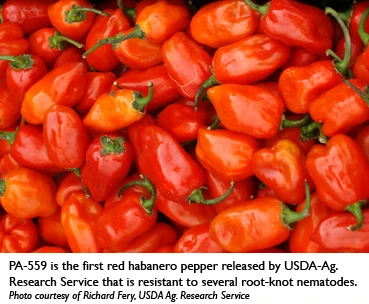
A new red-fruited habanero (PA-559) is the latest pepper with resistance to damaging nematodes to be released by USDA Ag. Research Service. Developed by scientists at the U.S. Vegetable Laboratory in Charleston, S.C., the pepper has resistance to the southern root-knot nematode, peanut root-knot nematode and the tropical root-knot nematode.
Root-knot nematodes are one of the three most economically damaging types of plant-parasitic nematodes on horticultural and field crops. They live in the soil in areas with hot climates and short winters. Damage from root-knot nematodes often results in poor plant growth, reductions in quality and yields and reduced resistance to stresses such as drought and disease.
PA-559 is a relative of another root-knot-nematode-resistant cultivar, TigerPaw-NR, which was released by the Ag. Research Service in 2006. Field plantings conducted in Charleston over two years confirmed PA-559's pest resistance and showed that its fruit characteristics are comparable to those of currently available red-fruited habanero cultivars. The plant's fruit is extremely pungent with 256,433 Scoville heat units. Habaneros typically measure 100,000 Scoville heat units or higher, whereas jalapeños range from 3,000 to 5,000 units. Although PA-559 is recommended for use by breeders as a parental line, it can also be used in commercial production without further development.
Latest from Greenhouse Management
- Millennium Pacific Greenhouses launches California Grown Cucumber Program
- Scientists develop vitamin A-enriched tomato to fight global deficiency
- Tennessee Green Industry Field Day scheduled for June 11
- UTIA and UT Knoxville research teams will develop automated compost monitoring system
- Ken and Deena Altman receive American Floral Endowment Ambassador Award
- [SNEAK PEEK] Leading Women of Horticulture: The women of Fairview Greenhouses & Garden Center
- [SNEAK PEEK] Leading Women of Horticulture: The inventive women of TPIE ’26
- Growing successful spring crops with Topflor