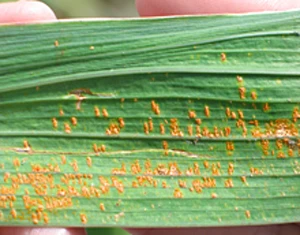
Gladiolus rust is a fungal pathogen that attacks the leaves of gladiolus and a few other flowering plants. It was first found in the U.S. in 2006 when it was identified on plants in two large Florida nurseries, which were quarantined by USDA, since the disease is considered of quarantine significance.
James Buck, a plant pathologist at the University of Georgia, joined a panel of experts to evaluate the extent of the pathogen’s infestation and to develop a plan to control it.
“Like other rust fungi, it causes lesions and produces spores primarily on the foliage,” Buck said.
When word of the disease got out, one Florida grower lost 30% of his business to a large supermarket chain, Buck said.
“We came up with different management options for the growers, they followed one, and eventually the pathogen was eliminated,” he said.
Florida is now free of the disease, but it’s now in California. Buck said the disease has not yet been found in Georgia.
The disease is in Mexico. To keep the disease from crossing the border into the U.S., Buck is working with Alberto Botin at the Univ. of Guadalajara in Mexico and Steve Jeffers at Clemson Univ. The researchers are testing fungicide treatments and evaluating varieties in fields south of Mexico City.
Pictured: Gladiolus rust was first found in the U.S. in 2006 when it was identified on plants in two large Florida nurseries, which were quarantined by USDA, since the disease is considered of quarantine significance.
Photo by Wayne Dixon, FDACS/DPI
Latest from Greenhouse Management
- The Growth Industry podcast Episode 10: State of the Horticulture Industry
- Millennium Pacific Greenhouses launches California Grown Cucumber Program
- Scientists develop vitamin A-enriched tomato to fight global deficiency
- Incubating invention
- Tennessee Green Industry Field Day scheduled for June 11
- UTIA and UT Knoxville research teams will develop automated compost monitoring system
- Ken and Deena Altman receive American Floral Endowment Ambassador Award
- [WATCH] Taking root: The green industry’s guide to successful internships