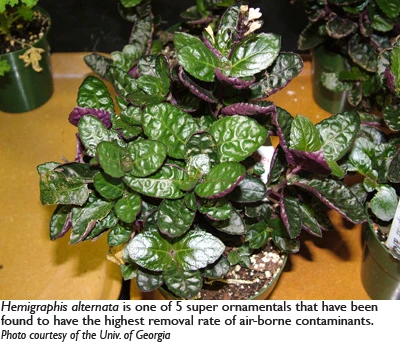
Univ. of Georgia researchers have shown that certain plant species can effectively remove air-borne contaminants, including harmful volatile organic compounds (VOCs). Of the 28 plants tested, the researchers identified 5 “super ornamentals,” which had the highest rates of contaminant removal, a process called phytoremediation. The plants included: Hemigraphis alternata (purple waffle plant), Hedera helix (English ivy), Hoya cornosa (variegated wax plant), Asparagus densiflorus (asparagus fern) and Tradescantia pallida (purple heart plant). The plants were exposed to a number of common household VOCs, including benzene, toluene, octane, alpha-pinene and TCE.
Univ. of Georgia scientists collaborated with researchers at Konkuk Univ. in Seoul and at the Nat’l. Horticultural Research Institute in Suwon, Korea. Results of the study were published in the August 2009 issue of HortScience.
VOCs emanate from furnishings, carpets, plastics, cleaning products, building materials like drywall, paint, solvents and adhesives. Even tap water can be a source of VOCs.
Univ. of Georgia hort. professor Stanley Kays said the researchers are interested in determining why some plants are very effective at remediation, while others show little promise. He said they also want to determine the species and number of plants needed in a house or office to neutralize the contaminants. He said the placement of ornamentals indoors has the potential to significantly improve indoor air quality.
Latest from Greenhouse Management
- The Growth Industry Episode 10: State of the Horticulture Industry
- Millennium Pacific Greenhouses launches California Grown Cucumber Program
- Scientists develop vitamin A-enriched tomato to fight global deficiency
- Tennessee Green Industry Field Day scheduled for June 11
- UTIA and UT Knoxville research teams will develop automated compost monitoring system
- Ken and Deena Altman receive American Floral Endowment Ambassador Award
- [SNEAK PEEK] Leading Women of Horticulture: The women of Fairview Greenhouses & Garden Center
- [SNEAK PEEK] Leading Women of Horticulture: The inventive women of TPIE ’26