Ben Verhoeven is the second-generation owner of Peoria Gardens in Albany, Oregon, following in the footsteps of his father, Tom, who started the business in 1983. The operation has five acres of covered production space and grows annual, vegetable and perennial starts for independent garden centers.
In early February, Peoria Gardens is performing much of its propagation, says Ben Verhoeven, president. “We've been growing our own plugs successfully for many years, but they take a very, very long time under those conditions,” he says. “They're also not the best-quality plugs. It’s just really hard — you can’t get a summer-quality plug in the dead of winter when you have that little light.”
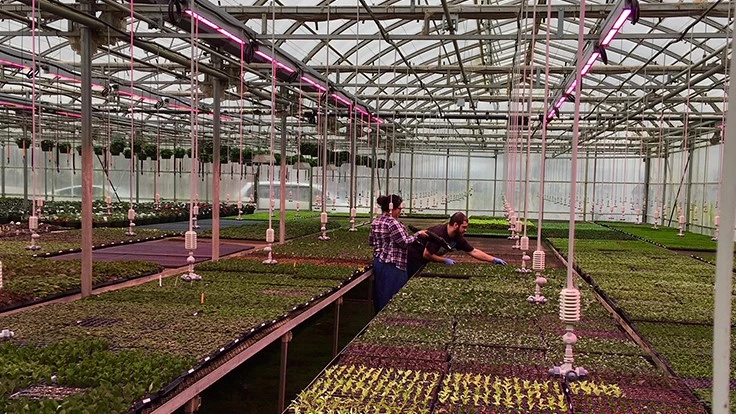
But in 2017, when Peoria Gardens installed Philips-brand LED toplighting in about a quarter of its roughly 16,000-square-foot propagation area, Verhoeven says the business began growing a “summer-quality plug” in the winter. “What we've seen this year is a vast improvement in the finish time of a plug, also in the quality of the plug,” he says. “They're more uniform, easier to send through automated transplanting equipment, etc.”
Philips lights are tuned to certain light spectra, designed to promote root growth and toned growth on top of plugs, Verhoeven says. “You don't get a lot of too lush of growth up top,” he says. “You don't want something that's floppy up top because it gets all hung up in automated equipment or even hand transplanting.”
Using the lights, Peoria Gardens has been able to extend its daily light integral (DLI) in early February from what Verhoeven estimates was possibly less than one mole of natural light per day, to 10, 11 or 12 moles per day. This means running the lights for about 16 hours a day, he says, beginning at around 1 a.m. and ending at about sunset, which at that time of year is about 4 p.m.
Peoria Gardens grows unrooted cuttings, as well as rooted cuttings and seeded product, and the URCs are under a different spectrum of light than the other plants, Verhoeven says. The LEDs help improve the health of the URCs, which the grower keeps under mist, because the humid, moist environment can be a catalyst for fungal pathogens. When it came to deciding which spectra to grow certain crops under, he says the company took the advice of professionals at Philips Lighting.
Peoria Gardens calculates the profitability of a plant based, in part, on dollars per square foot week, Verhoeven says. The LEDs improve rooting of the business’ plants, and therefore allows it to turn bench space quicker. “A plant pays rent when it's on the bench or on the ground, and the longer it's on the bench, the more rent it pays — the higher the production costs of that plant,” he says. “The faster you can get it off the bench and transplanted, the better.”
Designing and installing new electrical service can take utility companies months in Western Oregon, Verhoeven says. “Maybe it's different than the other parts of the country, but at least here in Western Oregon, they’ve got their own timeline and levels of bureaucracy that are staggering,” he says. “You should be prepared for that.”
However, LEDs have been so helpful to Peoria Gardens that installing them will be worth another wait, Verhoeven says. “We're planning on expanding [LEDs] to encompass all of our propagation,” he says.
Latest from Greenhouse Management
- Jackson & Perkins expands into Canadian market
- Green & Growin’ 26 brings together North Carolina’s green industry for education, connection and growth
- Marion Ag Service announces return of Doug Grott as chief operating officer
- Cincinnati Zoo & Botanical Garden debuting new perennial section at 2026 Breeder Showcase
- The Garden Conservancy hosting Open Days 2026
- Registration open for 2026 Perennial Plant Association National Symposium
- Resource Innovation Institute and North Dakota State University explore co-location of data center and greenhouses
- Fred C. Gloeckner Foundation Research Fund calls for 2026 research proposals