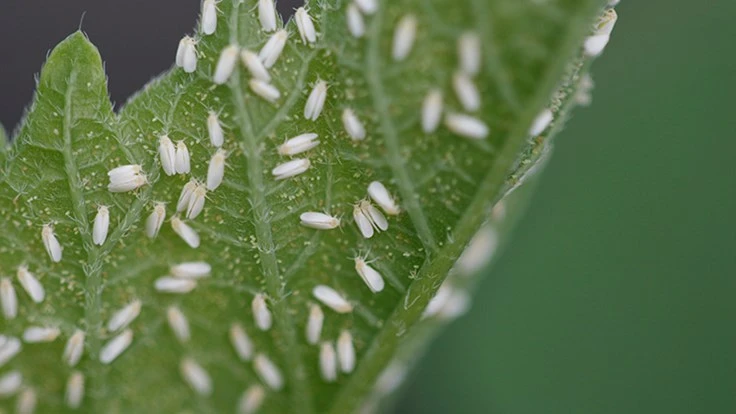
Photo via UF/IFAS Communications
The whitefly is back. Though it looks like the sort of adorable insect that would star in a Dreamworks film, the humble whitefly is actually a god-awful invasive species that will stop at nothing to decimate crops. The bug can carry more than 111 different plant-killing viruses — a wave of these little guys across the South in 1991 wiped out more than $500 million worth of crops.
"Vegetables were dying," says Dr. Lance Osborne, a University of Florida entomologist who has been studying whiteflies for 40 years. "The people picking those vegetables were displaced and had to move and find new homes. People in the world were starving because of whitefly-transmitted viruses."
Now, Osborne is frightened yet again. In 2005, University of Arizona scientists discovered a strain of pesticide-resistant whiteflies, which sparked a nationwide effort to contain the new strain. (The scary "biotype" is known as Bemisia tabaci type-Q, as opposed to the more easily contained Bemisia tabaci type-B.) The plan worked for more than ten years, but on April 25, a type-Q whitefly was found out in the wild for the very first time — in Palm Beach Gardens. On May 10, they were then spotted in Palm Beach. Then Boynton Beach and Boca Raton the next day.
For more information, click here.
Latest from Greenhouse Management
- Jackson & Perkins expands into Canadian market
- Green & Growin’ 26 brings together North Carolina’s green industry for education, connection and growth
- Marion Ag Service announces return of Doug Grott as chief operating officer
- Cincinnati Zoo & Botanical Garden debuting new perennial section at 2026 Breeder Showcase
- The Garden Conservancy hosting Open Days 2026
- Registration open for 2026 Perennial Plant Association National Symposium
- Resource Innovation Institute and North Dakota State University explore co-location of data center and greenhouses
- Fred C. Gloeckner Foundation Research Fund calls for 2026 research proposals