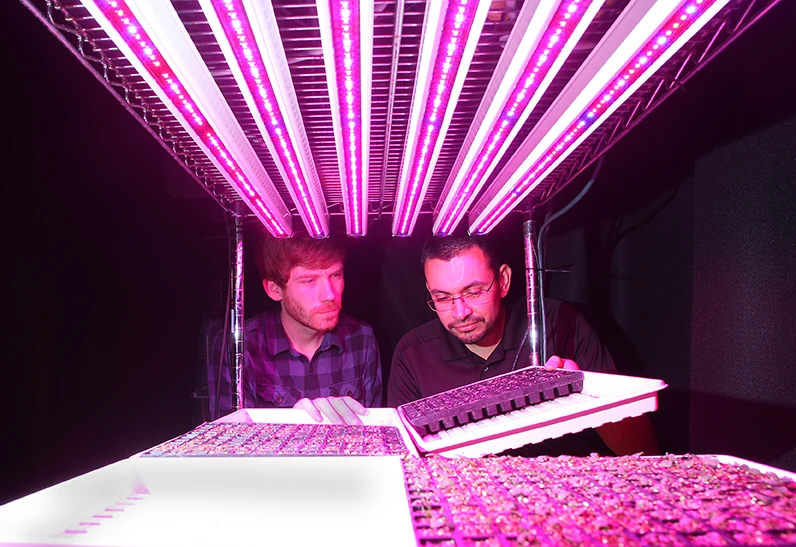
It’s no secret that increasing photosynthetic daily light integral (DLI) during young plant production improves overall quality such as rooting, stem caliper, branching, and reduces production time. Over the past seven years, Dr. Roberto Lopez, assistant professor and controlled environment and floriculture extension specialist at Michigan State University (formally at Purdue University), has performed numerous studies with Philips Lighting horticulture LEDs on young plants, beginning with research modules and then moving onto commercially available toplighting, production modules, and flowering lamps.
In multiple studies, Lopez and his graduate students have quantified the effects of supplemental lighting from LEDs versus high-pressure sodium (HPS) lamps with species such as petunia, geranium, impatiens, New Guinea impatiens, marigold, pansy, vinca, begonia, gerbera, tomato, pepper, lettuce and millet, on both plugs (seedlings) and liners (cuttings), Lopez says. Upon performing the studies in research greenhouses, the researchers validated their results in a commercial setting, at Galema’s Greenhouse in West Lafayette, Ind.
The Michigan State researchers found that in situations where the DLI outdoors is low — below seven mol·m?2·d?1 — they were able to further increase plug quality using supplemental lighting from LEDs, compared to plugs grown under HPS. “You’ll have more compact plugs; in some instances, you’ll have increased root dry mass, they’ll be greener, have reduced leaf area, so all positive attributes,” Lopez says. However, the added benefits of LEDs over HPS lamps were generally only apparent with bedding plant seedlings, and not rooted cuttings, and they are also species-specific, he says.
The takeaway? “From the research we have conducted over the past seven years, we have determined that LEDs can be a great replacement for HPS lamps,” Lopez says. When asked if growers should switch to LED supplemental lighting, Lopez says, “It’s a very company-specific decision, as there are a lot of factors that a grower needs to consider.”

Photo: Purdue University
In performing research with Philips LEDs, Lopez and his colleagues also found that they can produce an even higher quality bedding plant plug indoors using sole-source lighting. With the ability to precisely control carbon dioxide, temperature, humidity, light intensity and quality, growers who grow young plants indoors operate at an added cost, but he says they can increase uniformity and overall plug quality, and further reduce production time, shrink and the use of plant growth regulators (PGRs). “The future,” he says, could be in producing high-value young plants indoors.
“If you would had asked me five years ago if I thought that producing young plants indoors was a viable and good option, I probably would have laughed,” Lopez says. “But once we started doing the research and compared plugs produced indoors to those in a greenhouse, and provided them the same DLI, I was really surprised by how uniform, compact, and higher quality you could produce indoors, because you can really control the environment compared to the greenhouse.”
In addition to benefits such as improved plug quality, Lopez and his colleagues have found other benefits of utilizing LEDs, such as the ability to change the color of lettuce and purple fountain grass by providing end-of-production supplemental lighting with high percentages of blue light.
Top photo: Dr. Roberto Lopez (right) has studied the effect of supplemental and sole-source lighting utilizing LEDs during young plant production; Photo: Purdue University
Latest from Greenhouse Management
- The Growth Industry Episode 10: State of the Horticulture Industry
- Millennium Pacific Greenhouses launches California Grown Cucumber Program
- Scientists develop vitamin A-enriched tomato to fight global deficiency
- Tennessee Green Industry Field Day scheduled for June 11
- UTIA and UT Knoxville research teams will develop automated compost monitoring system
- Ken and Deena Altman receive American Floral Endowment Ambassador Award
- [SNEAK PEEK] Leading Women of Horticulture: The women of Fairview Greenhouses & Garden Center
- [SNEAK PEEK] Leading Women of Horticulture: The inventive women of TPIE ’26