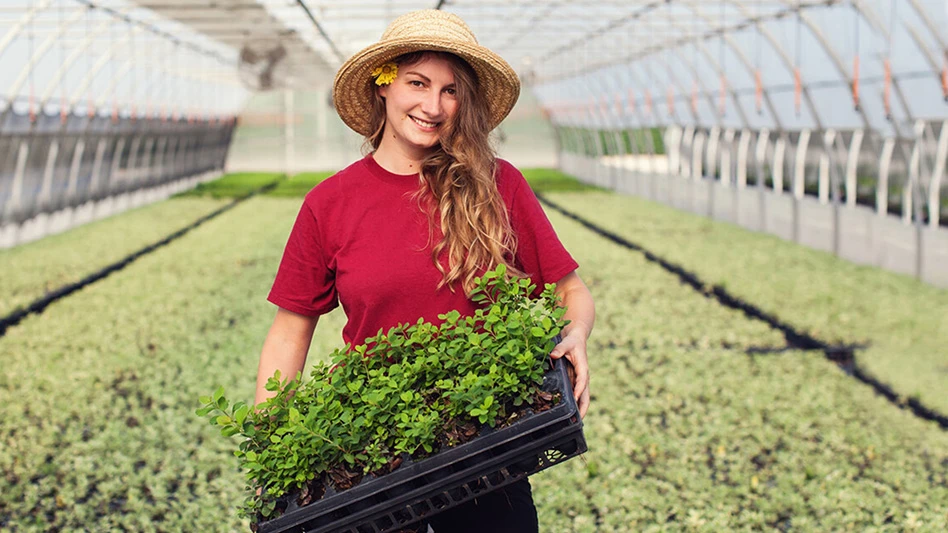
Skagit Horticulture, headquartered in Mount Vernon, Washington, produces liners for independent garden centers, landscapers, small chain stores and large-scale home stores in the United States and Canada. In its tissue culture lab and greenhouse in Mabton, Washington, the operation grows grasses, roses, apples, blueberries, blackberries, cherries, grapes and hops, says general manager Jerrin Victor.
In its 3,600-square-foot tissue culture lab, Victor says Skagit performed a side-by-side trial of Philips Lighting-brand LEDs next to fluorescent lights. "[With] all the crops that we are testing, we are seeing about two weeks of grow-time gain,” Victor says. “In other words, we can finish a crop two weeks earlier than [with] regular fluorescent lights.”
Calculations from Philips Lighting show that growers can see a 15 to 20 percent energy saving cost using LEDs instead of fluorescent lights, Victor says.
After the trial, Skagit installed the LEDs throughout its new tissue culture lab, where it runs them 16 hours per day. In addition to seeing a reduction in the time that its crops stay in the lab, Victor has noted that the crops are strong and vigorous.
In the event of a future tissue culture lab expansion, Victor says Skagit Horticulture plans to install more of the LEDs.
Skagit is experiencing comparable benefits from operating LEDs in about 7,000 square feet of its 10-acre Mabton greenhouse, too, Victor says, noting a growth advantage of about 10 to 14 days. “We are reducing our plant growth timeline by about two weeks, on average, on several species, which is really good for our space utilization," he says.
In the greenhouse, Skagit runs the LEDs from about 4 or 5 a.m. to about 8 or 9 a.m., and then again from about 6 p.m. to 8 or 9 p.m., Victor says. Although some parts of the Pacific Northwest, like Mount Vernon where Skagit is headquartered, are more often cloudy and it might make sense to run supplemental lighting throughout the day there, he says Mabton is sunny even in the winter and the sun provides sufficient natural light during the day.
The LEDs help Skagit’s crops with both root and shoot growth, Victor says, and the plants are more compact and less prone to stretching.
Overall, Victor says he had his doubts about the LEDs, but he is pleased with the results. “Compared to other lights, it is a bigger investment,” he says. “But I think the results show that there is benefit for that investment."
Latest from Greenhouse Management
- The Growth Industry Episode 10: State of the Horticulture Industry
- Millennium Pacific Greenhouses launches California Grown Cucumber Program
- Scientists develop vitamin A-enriched tomato to fight global deficiency
- Tennessee Green Industry Field Day scheduled for June 11
- UTIA and UT Knoxville research teams will develop automated compost monitoring system
- Ken and Deena Altman receive American Floral Endowment Ambassador Award
- [SNEAK PEEK] Leading Women of Horticulture: The women of Fairview Greenhouses & Garden Center
- [SNEAK PEEK] Leading Women of Horticulture: The inventive women of TPIE ’26