WholeTree is a growing media component made from all parts (bark, needles, wood and cones) of the loblolly pine (Pinus taeda). The product was developed by researchers at USDA-Agricultural Research Service and Auburn Univ. In 2005 and 2006, ARS, Auburn Univ. and Young’s Plant Farm, wholesale ornamental plant grower in Auburn, Ala., entered into cooperative agreements to develop the substrate.
The pine trees used for substrate are harvested from pine plantations at the thinning stage. The trees are chipped and further processed to achieve the desired physical properties needed for the substrate component.
Field and laboratory studies have demonstrated the successful use of Whole Tree, even at 100 percent for some plants. Young’s Plant Farm is producing its own substrate component. The company is growing and harvesting pine trees at one of its farms to make WholeTree.
Additional research is being conducted to evaluate the use of WholeTree in vegetative cutting and seedling propagation of perennials and woody ornamental crops. Plants that have been trialed include garden mums, salvia, climbing rose and Leyland cypress. Wholetree will also be looked at as a possible landscape soil amendment.
Scientists are planning to conduct additional plant growth response trials at other commercial grower locations in the Southeast. They will also be looking at other tree species growing in southern forests as either standalone substrates or as substrate components.
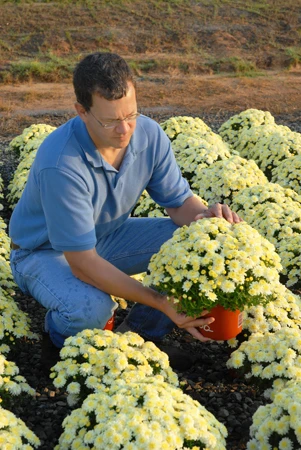
Pictured: Wholetree, a substrate produced from all the parts of loblolly pine trees, has been used to grow ornamental plants including garden mums.
Photo by Wayne J. Mclaurin
Latest from Greenhouse Management
- The Growth Industry Episode 10: State of the Horticulture Industry
- Millennium Pacific Greenhouses launches California Grown Cucumber Program
- Scientists develop vitamin A-enriched tomato to fight global deficiency
- Tennessee Green Industry Field Day scheduled for June 11
- UTIA and UT Knoxville research teams will develop automated compost monitoring system
- Ken and Deena Altman receive American Floral Endowment Ambassador Award
- [SNEAK PEEK] Leading Women of Horticulture: The women of Fairview Greenhouses & Garden Center
- [SNEAK PEEK] Leading Women of Horticulture: The inventive women of TPIE ’26