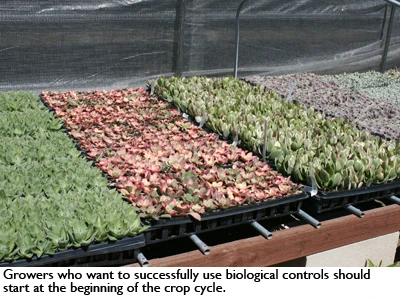
Growers who want to successfully use biological controls with their spring crops should start at the beginning of the crop cycle in the propagation house. Never start using biological controls in the middle of a crop cycle.
Univ. of Mass. ext. floriculture specialist Tina Smith and Univ. of Conn. ext. horticulture and greenhouse IPM specialist Leanne Pundt recommend that growers who purchase plant material from other growers, should request information on what specific pesticides were applied to the plants to ensure that no long lasting pesticide residues adversely impact biological controls. For example, organophosphate and pyrethroid pesticide residues may impact biological control agents for 3-4 months.
Growers sowing their own seed or propagating cuttings, can begin by using beneficial nematodes (Steinernema feltiae) as a preventive control for fungus gnats and for thrips larvae suppression. Nematodes do not control shore flies.
For shore flies and also fungus gnats, Atheta coriaria (rove beetle) is commonly used, applied one time during seed sowing or sticking cuttings. Atheta, which are easily established in greenhouses, should be reapplied when transplanting or repotting.
The predatory mite, Stratiolaelaps scimitus, formerly known as Hypoaspis miles, can also be used on fungus gnats during propagation. It is applied once during seeding or sticking. Hypoaspis are very mobile and will colonize the surface of the growing medium.
The predatory mite Amblyseius cucumeris can be used as a preventive for thrips in propagation areas. Amblyseius should be reapplied when transplanting or repotting.
Use yellow sticky cards to monitor for shore flies and fungus gnat adults and use potato wedges to monitor fungus gnat larvae.
Latest from Greenhouse Management
- The Growth Industry Episode 10: State of the Horticulture Industry
- Millennium Pacific Greenhouses launches California Grown Cucumber Program
- Scientists develop vitamin A-enriched tomato to fight global deficiency
- Tennessee Green Industry Field Day scheduled for June 11
- UTIA and UT Knoxville research teams will develop automated compost monitoring system
- Ken and Deena Altman receive American Floral Endowment Ambassador Award
- [SNEAK PEEK] Leading Women of Horticulture: The women of Fairview Greenhouses & Garden Center
- [SNEAK PEEK] Leading Women of Horticulture: The inventive women of TPIE ’26