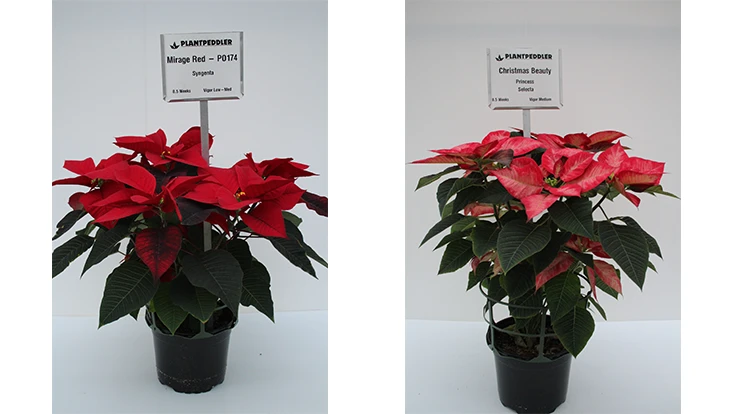
Photos courtesy of Plantpeddler
Plantpeddler, located in Cresco, Iowa, conducted a trial of over 125 commercial and pre-release Poinsettia varieties. Variety Day was hosted on Thursday, Dec. 6, with representatives of all major breeders, broker representatives, and growers in attendance. The trial was produced under natural season commercial production protocol.
“We are proud to showcase genetics under northern USA growing conditions," said Mike Gooder, president of Plantpeddler. "It is important to do a Poinsettia production trial as a way for the industry and our growers to see how varieties perform in real world greenhouse conditions where low temperatures and light levels are common during production.”
Genetics represented were submitted by Beekenkamp, Dummen Orange - Ecke and Red Fox, Rinehart Poinsettias, Selecta, Suntory, and Syngenta. Plantpeddler is licensed by all the represented breeders.
As a true production trial, the tested varieties were grown within a block of benchmark commercial varieties with the same treatments and environmental conditions. Northern Midwest weather played its role in this year’s trial results. Plants experienced average temperatures and light from plant date to flower initiation, with below average temperatures and low light levels during the finishing period. Only 6 days from October 20 to the trial reached 200+ mmol of light, with no days of 125+ mmol since November 6. Environmental varietal differences in plant response and timing varied, notable in some, with top performing varieties showing little effect.
Trial attendees voted using a three flag system for “Best Red Variety” and “Best Non-Red Variety” with a 3, 2, 1 point scoring. The results are as follows:

