

.JPG)

With fall crops and poinsettia sales coming to a close, now is the time to think about potential weed problems for next spring. Many times when weed problems occur, the growing medium is pointed out as the source of the problem; however, this is rarely true. If it were the source, the weeds would have to be native to Southern Canada where Sphagnum moss bogs, storage yards and packing facilities are located.
At first, it seems logical that the growing medium is the source of the weed seed. Hanging baskets are potted up in February, and in two weeks a few weeds emerge. There are no weeds on the floors (at least not until the floor warms up) nor outside the houses, so where did the weed seed come from? Weed problems that show up in winter actually started the previous summer and fall.
Where does the weed seed come from?
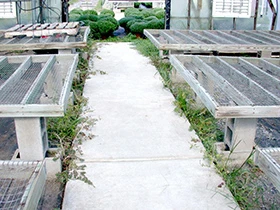
If weeds were growing on the floors, under the benches, near vents, in containers or around the perimeter of the greenhouses, they would have produced weed seed unless they were destroyed prior to going to seed. Once they go to seed, the greenhouses are contaminated and seed will find its way into crop creating a potential weed problem.
Weed seed can also come into the greenhouse by clinging to containers, flats, soilless media packaging, and other supplies that are stored in or around weeds. Reusing containers from plants that had weeds may have weed seed clinging to the pot or residual growing medium contaminated with weed seed. Even if the pots have been soaked in a bleach solution, any remaining weed seed can be viable.
In some cases, weed seed can come in with liners or plugs. The weeds or their seed may not be visible, but often they are there. Keep in mind the liners or plugs shipped to a grower in February were stuck or sown weeks earlier in a warmer climate where weeds could be actively growing. Some weeds have seed capsules that shoot seeds up to 20 feet. Before shipping, some growers will “clean-up” the weeds growing in their trays before they are packed, but weed seeds are scattered among the trays only to germinate after transplanting.
Where does the weed seed settle inside the greenhouse?
With airflow, static charge of greenhouse glazing and a weed’s ability to expel seeds a long distance, there are many places where weed seed can be lurking. Some locations include: adhesion to greenhouse plastic, on top of or inside fan jet tubes, in the casing of exhaust fans, on top of greenhouse support structures, potting benches, potting machines, greenhouse benches, greenhouse floors, etc.
How does a weed problem begin?
Wherever the weed seed is, it often finds its way into the growing medium. For example, if it is on the potting bench or clinging to pots or the growing medium bag, it will get incorporated into the growing medium. If it is in or on the fanjet tubes or exhaust fans, the weed seed will be disseminated onto the crops when the fans are on. If it is on the greenhouse glazing or structure, water will condense, forming drops that will take the weeds seed and drip onto the crop below.
A weed problem can begin as a minor issue with a few weeds emerging here and there. Often these weeds are not seen or ignored, especially in hanging baskets and stock plants. They eventually produce more seed that will spread to surrounding plants, germinate and result in a significant weed infestation.
Avoiding weed infestations
Regardless of the number of weeds growing in the greenhouse, they all pose the potential for significant weed infestation. Do not let any go to seed as this will prevent weed seed populations from increasing. When the houses are empty, apply herbicides that are registered for controlling weeds in a greenhouse. Make sure the houses are open to allow gases coming from herbicides to escape instead of accumulating on the glazing. If the houses contain crops, you will have to hand pull weeds. Mow all weeds within 20 feet of the greenhouses to keep them from going to seed. Store growing medium, pots, trays, etc. in areas where there are no weeds nearby. Following these tips will help minimize or eliminate future weed problems.
Latest from Greenhouse Management
- Jackson & Perkins expands into Canadian market
- Green & Growin’ 26 brings together North Carolina’s green industry for education, connection and growth
- Marion Ag Service announces return of Doug Grott as chief operating officer
- Cincinnati Zoo & Botanical Garden debuting new perennial section at 2026 Breeder Showcase
- The Garden Conservancy hosting Open Days 2026
- Registration open for 2026 Perennial Plant Association National Symposium
- Resource Innovation Institute and North Dakota State University explore co-location of data center and greenhouses
- Fred C. Gloeckner Foundation Research Fund calls for 2026 research proposals