With summer winding down and fall quickly approaching, now is a good time to evaluate the mum growing season. Following is a review of some key crop pointers for fall mums and how to avoid the main causes: plant stress.
Cold summer nights
Mums are “short day plants” meaning when the days become short, as in the fall, mums initiate flower buds. If mums are grown outdoors, there’s not much you can do about cold, summer night temperatures. Cold temperatures stress the plant and can lead to early flowering. To minimize the possibility of early flowering, constant feed at a rate of 250 to 350 ppm nitrogen, watch the watering and consider a hard pinch if flower initiation begins very early. However, you do not want to pinch later than mid to late July or you will delay flowering.
Monitor fertilizer rates
Often, towards the end of the crop, fertilizer is sometimes withheld to save on costs or to harden off the mums. However caution should be exercised since this can induce plant stress and cause early flowering. Constant feed throughout the crop cycle at 250-350 ppm nitrogen to lessen the effects of “stress” and the possibility of early flowering.

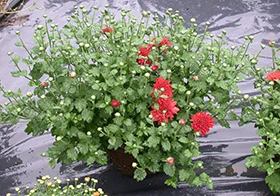
Mum flowering early from lack of fertilizer
If you use controlled release fertilizers, remember that temperature influences the release rate. For example, a three to four month controlled release fertilizer will last three to four months at 70°F (21°C), but only two to three months at higher summer temperatures. At these higher temperatures, there is an excessive early release of fertilizer and very little is leftover after two to three months. It is better to use a controlled release fertilizer with a six to nine month release to ensure consistent fertilizer availability over the entire crop cycle. Supplemental applications of water soluble fertilizer may be required toward the end of the crop.
Excessive watering or wilting
Keeping mums too wet or allowing them to severely wilt between irrigations can cause early flowering especially if the fertility is too low. Excessive watering or frequent rain also provides an ideal environment for Pythium root rot. Although mums can tolerate almost any general purpose growing medium, it is best to use a well-drained growing media with good quantities of aggregates and/or bark. Growing media with these ingredients drain well and dry out quickly, helping reduce problems associated with over watering.
Growing media and containers
Now is the time to look at the growing medium used for this season to determine how well it worked and if any changes are necessary. When selecting a growing medium, keep in mind the container size that will be used. Taller containers provide greater drainage of growing medium compared to shallow pots and mum pans. This is because the greater the column of the growing medium, the greater the effects of gravity to pull the water through the pot. Wider, shallow pots provide more stability to prevent plants from tipping over, however there is less effect of gravity to pull the water from growing medium. For comparison, if the same growing medium is used in a tall pot and a short pot with the same diameter, the saturated zone at the bottom of each pot will be the same height. Therefore, a shorter pot will have a greater percentage of growing medium that will remain saturated. With this in mind, a growing medium with low water-holding capacity and good drainage is better suited for shallow containers. Growing medium with low water-holding capacity may result in plants drying out too fast if used in tall containers. Tall containers may require a growing medium with high water capacity and less drainage.
Reviewing your cultural practices at this time can help identify crop strengths and weaknesses for this season and makes for great planning for a successful mum production for next season.
Latest from Greenhouse Management
- The Growth Industry Episode 10: State of the Horticulture Industry
- Millennium Pacific Greenhouses launches California Grown Cucumber Program
- Scientists develop vitamin A-enriched tomato to fight global deficiency
- Tennessee Green Industry Field Day scheduled for June 11
- UTIA and UT Knoxville research teams will develop automated compost monitoring system
- Ken and Deena Altman receive American Floral Endowment Ambassador Award
- [SNEAK PEEK] Leading Women of Horticulture: The women of Fairview Greenhouses & Garden Center
- [SNEAK PEEK] Leading Women of Horticulture: The inventive women of TPIE ’26