Monitoring growing medium pH and EC (electrical conductivity) of major crops along with knowing normal ranges is extremely important for quality crops. Why? The pH of the growing medium influences the availability of nutrients to the plant. EC measures the total salts in the growing medium that come from added fertilizer, water and acid. Knowing these values provides a good estimate of whether or not your plants are receiving sufficient levels of fertilizer.
Growing media samples can be easily sent off to a laboratory or you can test your own samples with portable pH and EC meters. If you test yourself, there are many types of pH and EC meters available on the market. Some are more expensive than others with prices ranging from $45 to $600. Selecting the best one(s) for your application depends on your needs and planned usage. The advantage of having your own testing equipment is that the results are available in real time so you can monitor and make adjustments to your crop(s).
pH meters: Pocket or portable meters (a box with an external wire running to the probe) are small in size and convenient. There are also non-portable, desktop models which are more expensive and offer more precision, but may be overkill for most applications. The best pH meters are those calibrated with at least two standards, such as a pH 4 and pH 7. Accuracy between these standards is good. Meters calibrated with one standard are only accurate near that standardized value, so this type of meter is not the choice. Another consideration is to purchase a meter with a replaceable electrode since its life expectancy is from one to three years, depending on how often it is cleaned and if it is stored in a storage solution.
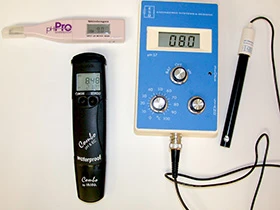
Various types of portable pH meters
Desktop combo pH and EC meter
Avoid inexpensive pH meters with thin metal probes that are pushed into the pot. They are designed for testing saturated media but are not very accurate. In addition, most of these meters cannot be calibrated to verify their accuracy.
pH electrode care: Most pH electrodes encased in glass or plastic need to be stored in a storage solution or a standard calibration solution. Never store the electrode in distilled water or let it dry out. If it dries out, it may require an hour or two of re-soaking in storage solution before it will provide reliable readings. In the worst-case scenario, improper storage can ruin the electrode.
There are a few portable pH meters with electrodes that can be stored dry. For some growers, this may be more convenient even if the meter is more expensive. Again those calibrated with two standard solutions are more reliable. The metal electrode will require periodic cleaning and avoid touching it as it is sensitive to electrostatic discharges.
EC meters: EC meters are also available in pen, portable and desktop models. Prices for pens and portables range from $50 to $400. Almost all EC meters are calibrated with only one standard solution. Select a meter whose range of measure covers most greenhouse applications (i.e. 0.5-5.0 mmhos/cm). It should have an automatic temperature compensator since the EC of a sample approximately doubles for every 55°F (13°C) change in temperature. Also, EC meters can have confusing terminology (see below). To avoid confusion, select a meter that reads in “mmhos/cm” which is universally used in the horticulture industry.
Conversion factors among EC units
1 mmhos/cm = 1 mS/cm = 1dS/m
1 mmhos/cm = 1000 μmhos/cm
1 mmhos/cm = 100 mhos x 10-5/cm
Various types of EC meters
EC electrode care: An EC electrode, unlike most pH electrodes, can be stored dry and usually does not require a storage solution. It will need periodic cleaning depending on how often it is used. Follow the manufacturer’s guidelines for electrode care. Also avoid touching the metal electrode as it, too, is sensitive to electrostatic discharges.
TDS: Many EC meters have the ability to measure TDS (Total Dissolved Solids). TDS measures the quantity of elements floating in the water or media solution, whereas EC measures the electrical charge created by them. TDS is actually estimated from the EC and is expressed in ppm (parts per million) or ppt (parts per thousand). The conversion factor between EC and TDS is variable, as seen below. Since TDS is not typically used in our industry, avoid conductivity meters that only read in TDS.
Conversion from EC to TDS
1 mmhos/cm = 500-700 ppm
1 mmhos/cm = 0.5-0.7 ppt
General meter usage tips: Regardless of the type of meter, do not store them in the greenhouse, where humidity can interfere with electrical signals and shorten the life of the meter. Each meter should be calibrated before use and after extended storage periods (at least once per month). Remember to use fresh standards to calibrate each meter. The more frequently a meter is calibrated, the more accurate the measure.
Using pH and EC meters are key grower tools for monitoring water, fertilizer solution(s) and growing media. The benefits of these meters far outweigh the initial cost. Measuring pH and EC values allow the grower to make adjustments and fine tune inputs for best crop results. Contact Premier Tech Horticulture Grower Services for more information and assistance.
Latest from Greenhouse Management
- Jackson & Perkins expands into Canadian market
- Green & Growin’ 26 brings together North Carolina’s green industry for education, connection and growth
- Marion Ag Service announces return of Doug Grott as chief operating officer
- Cincinnati Zoo & Botanical Garden debuting new perennial section at 2026 Breeder Showcase
- The Garden Conservancy hosting Open Days 2026
- Registration open for 2026 Perennial Plant Association National Symposium
- Resource Innovation Institute and North Dakota State University explore co-location of data center and greenhouses
- Fred C. Gloeckner Foundation Research Fund calls for 2026 research proposals