Disease prevention and prompt diagnosis are key components in vegetable seedling production said Mich. St. Univ. plant pathologist Mary Hausbeck. Relatively few fungicides are registered for controlling diseases on vegetable crops. She said as long as the greenhouse use is not prohibited and the specific vegetable is listed on the label, the fungicide can be applied.
Damping-off (caused by Pythium, Phytophthora and Rhizoctonia) affects all vegetable seedlings and is also common among flowering bedding plants. Damping-off results in collapse of the plant at the soil surface. To prevent damping-off, avoid over-watering because some fungi that cause damping-off prefer wet conditions.
Hausbeck said good sanitation is the key to preventing the diseases and ensures that pathogens from one crop are not transmitted between crops. Root rot pathogens survive in the greenhouse in soil particles or plant parts clinging to containers, benches, walkways and equipment. If root rot occurs, remove and destroy the diseased plants. Also, remove healthy-appearing plants that are immediately adjacent to dead plants because the disease may have already spread to them although they are not yet showing symptoms. Plug flats containing diseased transplants should not be reused.
Botrytis gray mold can infect all vegetable transplants and a wide range of floriculture crops. The pathogen produces gray masses of powdery spores. Symptoms include irregular brown spots or “blight” on leaves and stem cankers.
Botrytis is a threat when vegetable transplants form a canopy of leaves keeping the relative humidity high which favors disease. Increasing air circulation using horizontal airflow fans and reducing the relative humidity by venting or heating helps prevent condensation of water on plant surfaces and thereby reduce the occurrence of Botrytis. Watering early in the day enables plant foliage to dry reducing the occurrence of disease.
Alternaria blight causes leaf spotting and stem cankers on greenhouse vegetable transplants. The pathogen can be destructive when conditions are wet and the foliage is thick. Alternaria blight often does not become a problem until plants are held in the greenhouse for an extended period of time due to a delay in planting, shipping or selling.
The water mold Phytophthora infestans causes late blight, which is not considered a problem for tomato seedlings in the greenhouse. The late blight pathogen typically overwinters in potato cull piles and is often introduced to production fields via potato seed pieces.
Phytophthora sporangia (seeds) can be easily dislodged from a plant’s surface and carried long distances from one growing region to another via air currents and storm systems. Cloudy, rainy and humid weather allows Phytophthora sporangia to survive their travels so they can cause disease if they land on the surface of unprotected host plants (i.e. tomato, petunia and weeds such as nightshade). Under bright, sunny and dry conditions, Phytophthora sporangia cannot survive for long because the light breaks them down and the low relative humidity causes them to shrivel and die.
Control measures for Alternaria late blight are similar to those recommended for other tomato diseases and include keeping the foliage dry, providing good air ventilation, spacing plants and heating to lower the greenhouse humidity.
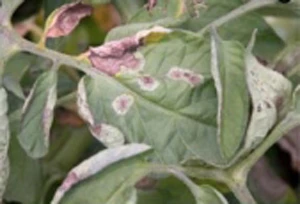
Pictured: Late blight on tomato is caused by Phytophthora infestans.
Photo by Mary Hausbeck, Mich, St. Univ.
Latest from Greenhouse Management
- The Growth Industry Episode 10: State of the Horticulture Industry
- Millennium Pacific Greenhouses launches California Grown Cucumber Program
- Scientists develop vitamin A-enriched tomato to fight global deficiency
- Tennessee Green Industry Field Day scheduled for June 11
- UTIA and UT Knoxville research teams will develop automated compost monitoring system
- Ken and Deena Altman receive American Floral Endowment Ambassador Award
- [SNEAK PEEK] Leading Women of Horticulture: The women of Fairview Greenhouses & Garden Center
- [SNEAK PEEK] Leading Women of Horticulture: The inventive women of TPIE ’26