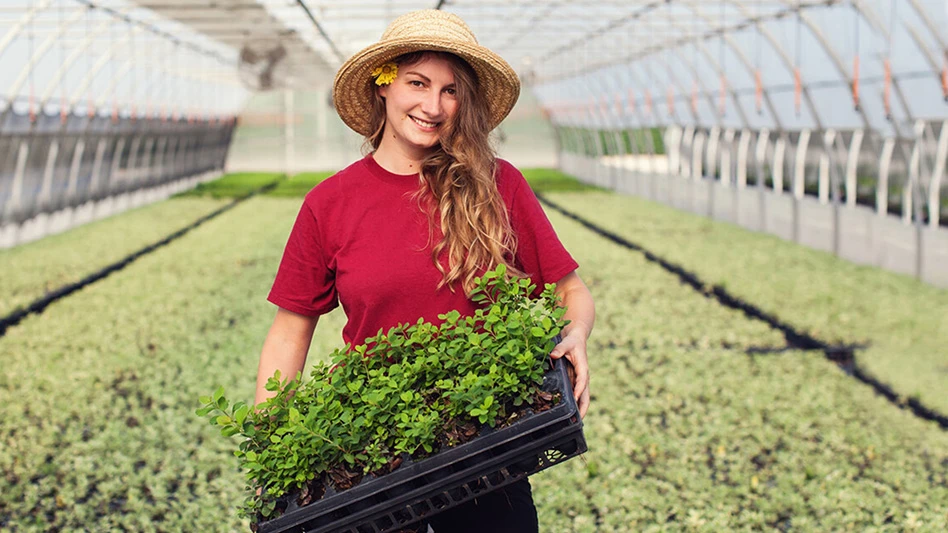
The challenge. What defines a sustainable plant? There seem to be as many definitions as there are plant varieties: locally grown, native plants, non-invasive plants, drought resistant plants and, of course, plants grown in sustainable ways. In February, this series addressed the final definition, plants grown in sustainable ways. Many of the sustainable labels got their start in the food industry, which has helped the public to understand the concepts. For example, “locally grown” has been embraced by the media with agriculture. The public understands the reasoning behind the benefits and often transfers that reasoning to ornamental plants. Yet, unless a garden center truly creates a niche market, selling purely from any one sustainable category isn’t commercially viable. So how does a retailer make selling multiple sustainable categories viable?
When you hear the phrase “green plants,” the first thing you think of, after the actual color, is plants grown either organically or sustainably.
But there are many other definitions surrounding this issue. Take a look at our primer, and decide which ones matter to your customers.
Locally grown. The appeal of locally grown plants is multifaceted. One, merchants who buy locally grown plants support the local economy. Two, less gasoline is used to deliver the plants.
Naturally, the issue isn’t so cut and dried. Locally grown plants are very desirable and should be promoted. Yet, how did the local grower get the plugs? Were they trucked in from across the country, shipped in from overseas or were the plugs also sourced locally? If the plugs are from a distance, which transport method is better -- ships arriving at nearby ports or long-haul trucks? Another issue is timing. In garden retail, having flowering plants in as early as possible is vital for garden centers that have a narrow sales window in spring. Northern garden centers rely on Southern growers to supply them with healthy, exuberant plants to stimulate sales in March and April. How do you weigh that financial reality against the benefits of locally grown?
Native plants. Native plants are touted because they support local animals and insects and are already part of the cycle of life. Foreign-born plants may or may not interact with local fauna.
That said, there are quite a few issues related to native plants. First, how do you define a native? On the surface, it’s obvious. If the plant came from and grows naturally in the local area, then it’s native to the local area. But some plants are labeled native if they are native to the state, region or even the
Also, once native plants hit the market, they’ve been modified. Breeders take the native and work to find versions that are the most attractive (which usually means less weedy looking). Gentle prodding of natives into better behaved plants won’t bother anyone but the most militant customer. But once they have entered the marketplace, breeders start playing with color, habit, drought tolerance and other qualities that make a plant so appealing for a home garden. Does that change how it interacts with local birds and butterflies?
Non-invasive. Invasive plants are both vigorous and aggressively self-propagating, to the point that they begin to crowd out native species and affect the local ecosystem.
Like native plants, there has been some confusion about exactly what deserves the invasive label. Plants that are native to one part of the country can be invasive in another part. But the Internet knows no state boundaries, and customers doing their research can be taken aback that you sell a “banned” plant.
Some state governments are stepping in to protect native species by banning invasive plants. Lawmakers, however, are not botanists, and problems can arise when entire species are banned, rather than the offensive plant. And where laws are more specific about botanic names, customers can mistakenly think that the entire line is banned.
Drought resistant. Gardening with drought-resistant plants is a great way to encourage homeowners to garden responsibly, especially in water-stressed areas. Many customers, however, mistake drought resistant with drought proof and fail to water the plants enough to keep them alive.
{sidebar id=3}
Other customers can be intimidated by watering charts -- if one plant needs more water than others planted with it, does that mean the drought tolerant plants will drown?
- Carol Miller
{tab=Suggestions}
What can you do?
Drought-resistant plants. The appeal of drought-resistant plants is tied strongly to water conservation. Retailers in drought-prone areas, or areas where reservoirs have not been created to keep up with population growth, should have a strong marketing campaign to promote these plants.
Unless you have a robust regional campaign to tap into, like the West’s X-Rated program (www.xratedgardening.com), then that means education. Seminars, newsletters and ad campaigns should promote drought-resistant plants and xeric gardening.
Locally grown. One of the most effective ways to promote locally grown plants is to identify the grower by name. Signs like, “Grown by John Smith in
Natives. You should have an in-store database with information about how plants behave in your location. Start adding the plants’ native range to that database, and make sure you label applicable plants as local to your state or even county and town. If you make it a standard part of your signs and labels, educating customers shouldn’t be overwhelming.
Non-invasives. Search the Internet occasionally to see which plants are showing up on invasive lists. If you sell plants on that list -- which you will, considering how many lists are out there -- make sure your employees understand why those plants are sold so they can explain those reasons to customers. If you discover that you are selling a plant that truly is invasive to your region, then be willing to cull the plant from your inventory. And be prepared to explain to customers why you did so.
{tab=Reality check}
To me, a plant is sustainable if it is well-adapted, doesn’t require a lot of water, is planted in the right place and doesn’t have to be replaced regularly. It is a valuable addition to the environment.
The word “sustainable” is something that wasn’t in our vocabulary until recently. I’m not sure what the customer’s version of sustainable is. Pick the native, well-adapted plant in the right place, and that’s a good choice no mater what word you use.
Drought-resistant/native plants. For some reason or other, when we have those plants they do not look beautiful. They don’t look good in 4-inch and 1-gallon [containers]. I used to keep the natives in one area. Retail is so much impulse, focused on what looks good right now. We have one day a year when we have our retail people together. They tell me they’d like to have a native area, and I explained the problem with displaying natives together. They love plants, they know [the ungainly natives are] fine, and obviously there’s an education to explain that to people.
It’s all the media, too. You look at ads in magazines, the whole push by the [growers] -- they’re always perfect all the time. Customers think that’s what they need to buy.
Locally grown plants. I would always prefer to have locally grown plants. It’s easier in a number of ways, especially for a small place. I like not having to buy huge volumes because you can do it every week.
Shipping is huge, and it’s getting bigger and bigger with fuel prices. I like to support small vendors as well, since I’m small, too. That’s not to say that I don’t buy from
We get a lot of vegetables from
In a lot of ways they are doing it correctly because they are using less energy, but that doesn’t help when the consumer wants that plant now. Plus, I’m thinking that it could be my fault for not pushing the local growers.
Invasives. I pay attention to it, but what is written nationally isn’t necessary true here. Burning bush is not invasive in
- Ruth Kinler, Redenta’s,
{tab=Product feature}
|
Type of |
Materials |
What you need to know |
|
Systemic |
N/A |
While several methods have been tested, |
|
Contact |
Citric acid, acetic acid (key ingredient |
Needs repeat application, since it destroys |
|
Suppressant |
Mulch/compost, corn gluten, landscape |
Suppressants work by using a layer of material to prevent weeds from reaching sunlight, with the exception of corn gluten, which works by dehydrating tender shoots as they emerge from the soil. For mulch or compost to work as a weed control, most pundits recommend a 4-inch layer. Corn gluten breaks down fairly rapidly and will require more than one application. There is some debate about landscape cloth and mats among organic enthusiasts. It’s argued that those that are truly impermeable will starve the soil underneath of oxygen and nutrients it needs to be healthy. |
|
Physical |
Flames, steam |
Both flame and steam work similarly. Plant cell walls burst at about 130° F. Flame is used by growers and obviously isn’t going to be practical (nor legal, most likely) for homeowners. Steam at this point is not cost effective for growers. Like contact herbicides, steam and flame controls affect only those parts of the plants exposed, not the rizome or roots. |
|
Manual |
N/A |
Most organic gardening guides tout the wonders of manually removing weeds through old-fashioned work. Some methods are the traditional hoeing and forking. Others are more labor intensive, like digging a series of furrows, burying the weeds in soil. An
|
{tab=Solutions}
Gardening solutions
To lessen the damages that toxic lawn-care products can do to the environment, GET MicroSolutions gives consumers a conscientious gardening solution. Products such as GET Growing and GET Green are all-natural, organic treatments for lush, low-maintenance lawns. The products attach to a standard garden hose to deliver a precise mixture during routine watering.
Soy candles
Designed for candle consumers seeking a healthier home and environment, Soy Basics candles provide vibrant colors and long-lasting fragrances without the need for petroleum-based ingredients. Stabilized soy wax candles avoid the soot and carcinogens that blended wax candles can produce.
Container watering kit
The Proven Winners WaterWise Easy Container Watering Kit makes it convenient for gardeners to water container plants, hanging baskets, flower boxes and plants in landscape beds. The product is an easy-to-use, self-contained kit that has everything a homeowner needs to water up to 10 containers from a single faucet.
Personal-care line
Simply Be Well has a complete personal-care product line created from certified organic ingredients. The ultra-hydrating body balm contains organic oils of coconut and sunflower seed combined with organic shea butter to moisturize dry skin. There are no artificial colors or preservatives.
Bat guano fertilizer
eBio Express International sells organic bat guano fertilizer that provides an alternative to chemical-based products. The Tropical Quality formulation is an effective fertilizer for rooting, growth and flowering.
Natural products
Save Your World products are available in an extensive line of pure organic yerba mate and pure organic aloe vera-infused natural shampoos, conditioners, body lotions, shower gels and exfoliating soaps with glycerin. Save Your World goes to great lengths to ensure that its natural products are made in an environmentally sensitive manner.
{/tabs}Latest from Greenhouse Management
- The Growth Industry Episode 10: State of the Horticulture Industry
- Millennium Pacific Greenhouses launches California Grown Cucumber Program
- Scientists develop vitamin A-enriched tomato to fight global deficiency
- Tennessee Green Industry Field Day scheduled for June 11
- UTIA and UT Knoxville research teams will develop automated compost monitoring system
- Ken and Deena Altman receive American Floral Endowment Ambassador Award
- [SNEAK PEEK] Leading Women of Horticulture: The women of Fairview Greenhouses & Garden Center
- [SNEAK PEEK] Leading Women of Horticulture: The inventive women of TPIE ’26