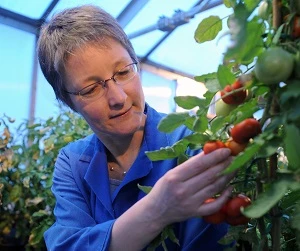
.jpg) Esther van der Knaap (Photo by Ken Chamberlain)WOOSTER, Ohio -- Do you enjoy big, plump tomatoes? If so, you should give thanks to a gene that arose thousands of years ago as early farmers in South America began domesticating this popular fruit, according to Ohio State University crop scientists.
Esther van der Knaap (Photo by Ken Chamberlain)WOOSTER, Ohio -- Do you enjoy big, plump tomatoes? If so, you should give thanks to a gene that arose thousands of years ago as early farmers in South America began domesticating this popular fruit, according to Ohio State University crop scientists.
Esther van der Knaap, a geneticist with the university's College of Food, Agricultural, and Environmental Sciences, led an international research team that discovered and cloned a gene that regulates fruit size in tomato. This is only the second domestication gene involved in fruit size ever cloned in any vegetable or fruit crop.
The discovery was reported Sept. 30 in the Proceedings of the National Academy of Sciences.
"This work represents an important improvement in the understanding of the regulation of fruit size and how domestication played a role in the selection of this gene," said van der Knaap, who is based on the Wooster campus of the Ohio Agricultural Research and Development Center (OARDC), the research arm of the college.
The cloned gene, known as SlKLUH, impacts fruit size by increasing cell layers and delaying ripening. According to van der Knaap, this gene promotes extra cell divisions during the process of fruit development, immediately after fertilization. These extra cell divisions lead to enlarged fruit, while the delay in ripening is likely the result of an extension of the cell division stage.
Click here to read more.
Latest from Greenhouse Management
- The Growth Industry podcast Episode 10: State of the Horticulture Industry
- Millennium Pacific Greenhouses launches California Grown Cucumber Program
- Scientists develop vitamin A-enriched tomato to fight global deficiency
- Incubating invention
- Tennessee Green Industry Field Day scheduled for June 11
- UTIA and UT Knoxville research teams will develop automated compost monitoring system
- Ken and Deena Altman receive American Floral Endowment Ambassador Award
- [WATCH] Taking root: The green industry’s guide to successful internships