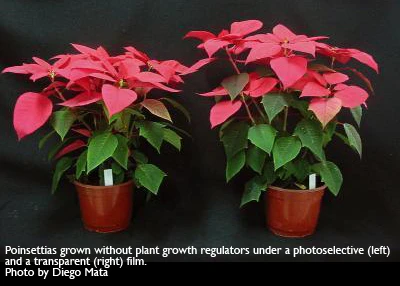
Two Argentine researchers conducted a study to determine if light wavelength manipulation could be used as an alternative method of growth control for plant growth regulators. Writing in Hort Science, Diego A. Mata of the Instituto de Floricultura (INTA) and Javier F. Botto of the Universidad de Buenos Aires evaluated the impact of different ratios of red and far red light using photoselective plastic film on the plant architecture and quality of ‘Freedom Red’ poinsettia. The photoselective film significantly reduced the far red component of the light, and a transparent film was used as a control. Science Daily reports that plants grown under a high red/far red ratio were shorter and more compact than those grown under transparent film. Flowering time was slightly delayed in plants grown under a high red/far red ratio compared with those under the transparent film. Other quality characteristics like bract and leaf area, number of lateral branches, stem diameter and plant width were not significantly different between treatments. Although the scientists indicated that light quality manipulation is an alternative strategy to control plant growth, they suggest that growers try the technique first on a small group of plants to determine its feasibility on a commercial scale.
Latest from Greenhouse Management
- Millennium Pacific Greenhouses launches California Grown Cucumber Program
- Scientists develop vitamin A-enriched tomato to fight global deficiency
- Tennessee Green Industry Field Day scheduled for June 11
- UTIA and UT Knoxville research teams will develop automated compost monitoring system
- Ken and Deena Altman receive American Floral Endowment Ambassador Award
- [SNEAK PEEK] Leading Women of Horticulture: The women of Fairview Greenhouses & Garden Center
- [SNEAK PEEK] Leading Women of Horticulture: The inventive women of TPIE ’26
- Growing successful spring crops with Topflor