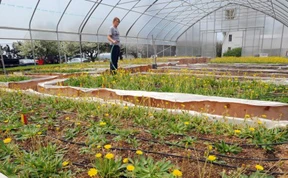
Ford Motor Co. is joining forces with Ohio St. Univ. scientists at the Ohio Agricultural Research and Development Center in Wooster to find new uses for an alternative source of rubber. The automaker is interested in substituting synthetic rubber used in plastic parts such as cupholders, floor mats and interior trim with natural, domestically grown rubber from Taraxacum kok-saghyz. The plant, commonly known as Russian dandelion, is native to the former Soviet republics of Kazakhstan and Uzbekistan.
OARDC crop scientists and engineers have been developing a commercially viable crop and an effective way to extract rubber from the plant’s fleshy roots, which can contain 15% or more of the sticky latex. The better-performing plants are being grown in greenhouses, high tunnels and a 2-acre field on the Wooster campus. Plans are underway for developing larger plantations and a pilot-scale processing facility.
Ford will perform its own testing of the rubber for characteristics such as strength, softness, impact resistance, durability, aging resistance, elasticity and memory. Ford officials said the rubber could potentially be used as a modifier to help improve the impact strength of plastics.
Ford is also looking at using guayule, a southwestern U.S. shrub, as a source of natural rubber. Before joining OARDC in 2010, Katrina Cornish, who is the current endowed chair in bio-based emergent materials at OARDC, developed and commercialized technology to obtain rubber and other industrial projects from guayule.
Photo courtesy of Ohio St. Univ.-OARDC
Latest from Greenhouse Management
- Jackson & Perkins expands into Canadian market
- Green & Growin’ 26 brings together North Carolina’s green industry for education, connection and growth
- Marion Ag Service announces return of Doug Grott as chief operating officer
- Cincinnati Zoo & Botanical Garden debuting new perennial section at 2026 Breeder Showcase
- The Garden Conservancy hosting Open Days 2026
- Registration open for 2026 Perennial Plant Association National Symposium
- Resource Innovation Institute and North Dakota State University explore co-location of data center and greenhouses
- Fred C. Gloeckner Foundation Research Fund calls for 2026 research proposals