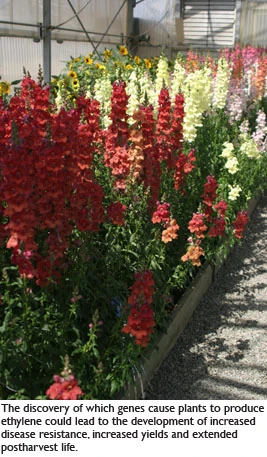
Scientists at the USDA Plant Gene Expression Center have discovered how a family of genes is responsible for the production of ethylene gas. The find, which was reported in the journal Genetics, could lead to the development of increased disease resistance, increased yields and extended postharvest life. Senior scientist Athanasios Theologis said the information provided by the ACS genes could be used to assist in the engineering of plants that are more suited for the changing world, reports DNA India. The researchers determined that the loss of a single ACS gene had no visible effect on the plant, but it did affect the activity of other genes in the family. By growing plants with different gene combinations, members of the gene family have different but overlapping functions on plant development, including growth, time to flower, disease resistance and gravitostimulation.
Mark Johnston, editor-in-chief of Genetics, said by determining how plants regulate the amount of ethylene they produce, this provides researchers with a new way to develop more productive crops. He said this was particularly important in regards to global warming and increased populations.
Latest from Greenhouse Management
- Jackson & Perkins expands into Canadian market
- Green & Growin’ 26 brings together North Carolina’s green industry for education, connection and growth
- Marion Ag Service announces return of Doug Grott as chief operating officer
- Cincinnati Zoo & Botanical Garden debuting new perennial section at 2026 Breeder Showcase
- The Garden Conservancy hosting Open Days 2026
- Registration open for 2026 Perennial Plant Association National Symposium
- Resource Innovation Institute and North Dakota State University explore co-location of data center and greenhouses
- Fred C. Gloeckner Foundation Research Fund calls for 2026 research proposals