Protecting poinsettia crops from the onslaught of whiteflies is of the utmost importance. But it’s equally important to prevent burn on the plant. So growers must know which chemicals are safe for their plants and effective against whiteflies.
To help growers clarify which chemicals they can use, Jim Barrett, a professor in department of environmental horticulture at the University of Florida, performed an efficacy trial, last fall, on Rycar, SePRO’s insecticide for whitefly and aphid control.
“Whitefly is a particular problem on poinsettia crop,” Barrett says. “In warmer climates, we have a lot of whiteflies that come in from outside and because the temperature is warmer, the life cycle is much shorter.”
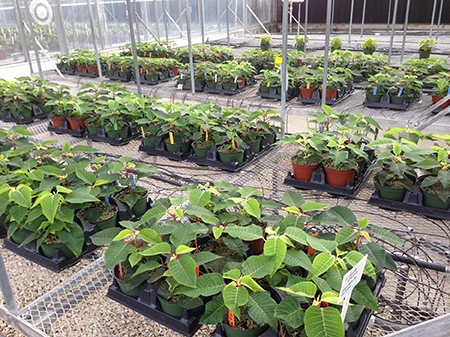
Barrett says he and his team put poinsettia plants into a section of greenhouse with a high concentration of whitefly.
The first group of poinsettia plants, the control group, were left untreated throughout the study. Three other groups of plants were the introduced. One group was treated with Rycar, and the other two groups were treated with insecticides that also control whitefly.
.jpg)
Applications of each chemical were made, and then the plants were examined continuously over a 32-day period. Barrett says that after 17 days, the control group had 38 immature whiteflies (pictured right). One of the treated plant groups had 30 immatures. Another group of treated plants had one immature whitefly. The Rycar treated plants had four immatures.
And the chemicals were extremely effective at preventing immatures from growing into adults.
“After 17 days of treatment there were no adults on the Rycar plant. On the control, there was something like 30 adults,” Barrett says. He adds that the whitefly population present in the experiment was far higher than would be present in a commercial greenhouse. “So these are very effective chemicals,” he says.
Another issue for poinsettias, Barrett says, is sooty mold. Whiteflies secrete a honeydew after fluids pass through their body. Their secretions are heavy with sugar, so a mold will frequently grow atop the secretion. The mold is frequently black which lends it the sooty mold.
This fire burns
Barrett’s research also focused on the potential for poinsettia burn with Rycar.
“One of the components of our research was looking at spray levels with Rycar that were quite above the normal use rate,” he says. “We went to that higher rate because there is potential for a grower to use the wrong rate or mix it wrong.”
He says that he examined the crop two weeks after pinching and did not see any phytotoxicity problems. “Then we came back, later in the crop, when the plants were developing bracts and flowering. And we didn’t see any injury from the spray and we did not see any residue.”
And while the safe use of Rycar, combined with its efficacy, make it an attractive chemical for growers, Barrett still recommends that growers build a rotation against whitefly.
“There is no silver bullet,” he says. “We have to be pretty aggressive in whitefly control.”
Latest from Greenhouse Management
- The Growth Industry Episode 10: State of the Horticulture Industry
- Millennium Pacific Greenhouses launches California Grown Cucumber Program
- Scientists develop vitamin A-enriched tomato to fight global deficiency
- Tennessee Green Industry Field Day scheduled for June 11
- UTIA and UT Knoxville research teams will develop automated compost monitoring system
- Ken and Deena Altman receive American Floral Endowment Ambassador Award
- [SNEAK PEEK] Leading Women of Horticulture: The women of Fairview Greenhouses & Garden Center
- [SNEAK PEEK] Leading Women of Horticulture: The inventive women of TPIE ’26