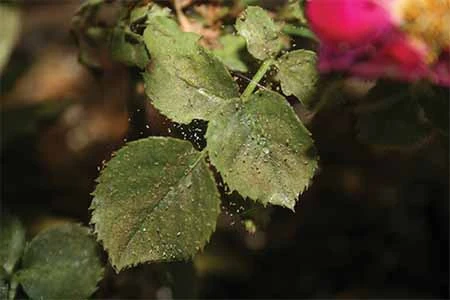
Twospotted spider mites are destructive pests that ravage a wide host of plants and crops. Developing a thorough scouting system, and having the right tools to fight infestations, can help prevent crop loss to these pests.
Raymond Cloyd, professor and extension specialist in horticultural entomology/plant protection at Kansas State University, says that twospotted spider mites prefer hot, dry conditions.
“Twospotted spider mite is a warm season mite, making it very prevalent in the mid-spring to late fall. That’s when you’ll have the most problems with twospotted spider mites, mainly because the lifecycle is shortened during that time period when it gets over 85 degrees Fahrenheit. During that time, the lifecycle from egg to adult can be completed in about seven days,” he says.
Twospotted spider mites have sucking mouth parts, Cloyd notes, meaning they do damage by feeding on the underside of leaves and sucking the chlorophyll or green leaf pigment, resulting in a stippling appearance. Severe infestations can cause leaves to drop off and massive webbing on plants, he says.
A wide range of plants can be devastated by twospotted spider mites, including: tropicals, certain annuals and perennials, and even herbs and vegetables, Cloyd says. To prevent the pest from taking hold, he recommends a strong scouting program.
Tips for prevention:
- Remember that spider mites are not going to be captured on yellow sticky cards, so this involves actual visual inspections of plants.
- “One technique that I recommend is taking a clipboard with a white piece of paper and knocking the flowers or foliage over it and looking for the mites. The adults will be very distinct. They’ll be crawling around and will have two black spots on both sides of the abdomen. That’s probably the best way to scout directly for twospotted spider mite,” Cloyd says.
- Try to know which plants are particularly susceptible to twospotted spider mites because those are the ones you want to target for special scouting. If populations get out of hand it can become very difficult to deal with them, either with biological control or with miticides.
If you begin to notice twospotted spider mites in your greenhouse, Cloyd says there are two options depending on the size of the infestation.
- If you have a population that’s way out of hand the best thing to do is to rogue out the infested plants and the ones near them and initiate some type of miticide program.
- The other thought is: If you are scouting early and you detect hot spots, localized infestations, you can utilize miticides to target those areas.
“Now, we have a pretty good selection of miticides commercially available but using them correctly is important. There are two things that really need to be taken into consideration,” Cloyd says.
- “Thorough coverage of all plant parts. Many miticides are contact only. Some have translaminar ability, meaning the material penetrates through the leaf tissue and even after the material dries, there’s some level of active material in the leaf. So when spider mites come along later and stick their mouth parts in the leave they can still ingest lethal concentrations.
- “The most important aspect of using a miticide for spider mite population is rotation modes of action. Use one mode of action within one generation and then switch, to avoid the prospect of resistance.”
Latest from Greenhouse Management
- Jackson & Perkins expands into Canadian market
- Green & Growin’ 26 brings together North Carolina’s green industry for education, connection and growth
- Marion Ag Service announces return of Doug Grott as chief operating officer
- Cincinnati Zoo & Botanical Garden debuting new perennial section at 2026 Breeder Showcase
- The Garden Conservancy hosting Open Days 2026
- Registration open for 2026 Perennial Plant Association National Symposium
- Resource Innovation Institute and North Dakota State University explore co-location of data center and greenhouses
- Fred C. Gloeckner Foundation Research Fund calls for 2026 research proposals