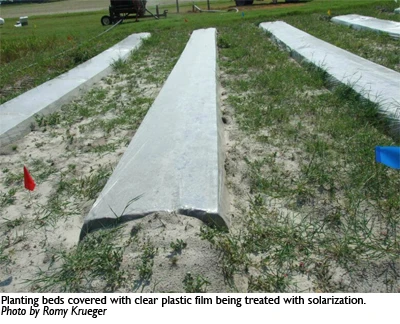
Soil solarization is a process where growers cover planting beds with clear plastic sheets for several weeks during the summer, trapping heat that destroys weeds, nematodes and fungi. Popular in California and Israel, researchers and growers in Florida are studying the feasibility of implementing the practice, which is seldom used there. Bob McSorley, a Univ. of Fla. nematology professor is working with Sunshine State Carnations in Hobe Sound, Fla., to determine the practicality and effectiveness of solarization. A study published in the current issue of the Int’l. Journal of Pest Management showed solarization effectively prepared planting beds for snapdragons, in some cases as well as the soil fumigant methyl bromide. Growers and researchers are seeking cost-effective alternatives to soil fumigants. “The big challenge is getting (growers) to adopt it,” said McSorley. “They never thought of doing without soil fumigants.” He recommends interested growers try solarization on a small plot to determine if it gives the results they need.
He said the advantages of solarization are that it’s inexpensive and environmentally friendly, although the plastic sheeting does require disposal. The downside is solarization requires intense sun exposure, so it can only be used during summer, to prepare beds and fields for fall-grown crops. Also, 3-4 months after solarization is used, pest organisms start to return.
Last year, Sunshine State Carnations took part in an USDA solarization study. It was successful, and this year the company plans to trial solarization on ½-acre plots at both its Hobe Sound and Palm City locations. Peter Nissen, co-owner of Sunshine State Carnations, says if this year’s study goes well, his company will use solarization on a larger scale in rotation with soil fumigants. USDA plant pathologist Dan Chellemi said solarization has “tremendous potential” for Florida floriculture and vegetable growers, when used as part of an integrated pest management program. McSorley is planning to publish an extension bulletin in 2010 on solarization for home garden use.
Latest from Greenhouse Management
- The Growth Industry Episode 10: State of the Horticulture Industry
- Millennium Pacific Greenhouses launches California Grown Cucumber Program
- Scientists develop vitamin A-enriched tomato to fight global deficiency
- Tennessee Green Industry Field Day scheduled for June 11
- UTIA and UT Knoxville research teams will develop automated compost monitoring system
- Ken and Deena Altman receive American Floral Endowment Ambassador Award
- [SNEAK PEEK] Leading Women of Horticulture: The women of Fairview Greenhouses & Garden Center
- [SNEAK PEEK] Leading Women of Horticulture: The inventive women of TPIE ’26