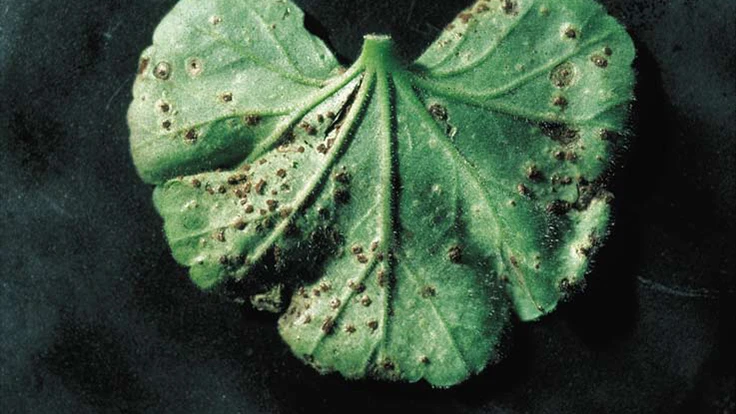
It can be easy to miss the signs of rust at first glance because it gets its start on the undersides of leaves. When the disease has spread to multiple leaves, “It can be so disfiguring that there’s no bringing plants back,” says Jen Browning, a BASF technical service representative.
Rust has a broad range of hosts and appears in different forms, including orange, black, and grey rust pustules. “It will also utilize multiple hosts, spending alternating seasons on different plants,” Browning says. “[In this scenario], you’re not just managing the disease on one host, but multiple hosts and throughout the year.”
Treating rust
Some products will provide early curative ability to stop the progression of rust so quickly that the plant can grow past it. This is possible only when pressure is low – before its levels surge and leaves become engulfed, Browning says. “Maybe you have noticed the early signs of rust developing, and you’ve not treated those plants; that’s a scenario where Orkestra™ Intrinsic® can stop the disease, and the plants will outgrow the damage.” When plants have waxier or thicker foliage, incorporating an adjuvant will help to manage rust infections.
An end-of-production exception
“When a grower is going to carry plants over winter, they may be a little more tolerant of damage from pathogens or from insects late in the season,” Browning says. “They have time the following spring, particularly with a preventative program as soon as plants emerge from dormancy.”
Latest from Greenhouse Management
- Jackson & Perkins expands into Canadian market
- Green & Growin’ 26 brings together North Carolina’s green industry for education, connection and growth
- Marion Ag Service announces return of Doug Grott as chief operating officer
- Cincinnati Zoo & Botanical Garden debuting new perennial section at 2026 Breeder Showcase
- The Garden Conservancy hosting Open Days 2026
- Registration open for 2026 Perennial Plant Association National Symposium
- Resource Innovation Institute and North Dakota State University explore co-location of data center and greenhouses
- Fred C. Gloeckner Foundation Research Fund calls for 2026 research proposals