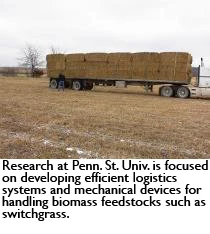
A number of ag crops, including switchgrass, are being considered as alternative biofuels for oil and coal. Selecting the best plants to use as biofuels is only part of the challenge. How to handle large quantities of biofuels must also be resolved.
Jude Liu, assistant professor of ag and biological engineering at Penn. St. Univ., recently received a $100,000 grant from the Sun Grant Initiative to study the logistics of handling massive quantities of biomass.
“Some estimates indicate a commercial-scale cellulosic ethanol bio-refinery designed for 24-hours-a-day, seven-days-a-week, year-round production would require a minimum of 1,000 tons of feedstock material per day,” Liu said. “This equates to approximately 1,800 large rectangular bales of switchgrass every day. One can imagine the number of trucks required and costs of handling these bales.”
Liu's research focuses on bale-handling and bale-densification technologies. He said long-term goals are to develop efficient logistics systems and mechanical devices for handling biomass feedstocks in a safe, low-cost and efficient manner. He is designing mechanical devices to compress and transport bales in order to save storage space, maximize load capacity of transport trucks and accelerate the loading and unloading processes. Also, Liu said that because of public concerns and landowners' expectations, the biomass feedstock will need to be harvested, collected and handled in a sustainable way.