Signify
It’s natural for Allison Driskill and Colin Brice to put themselves in the shoes of produce growers who cultivate crops under cover because they’ve worn them before.
They know firsthand how challenging it is to decide between various and necessary upgrades in a controlled environment greenhouse facility and weighing which one to tackle first.
Before they became key account managers on the Philips Horticulture LED solutions team at Signify, Driskill launched and operated a leafy greens business in North Carolina called Blue Thumb Farms, and Brice started a microgreens company, where he sold his harvest to restaurants in East Tennessee.
They know upgrading to light-emitting diodes (LEDs) is just one of many choices business owners confront each season. They also know how even a small increase in supplemental lighting at just one stage of plant growth can help transform an operation.
“As you start building a business, you're responsible for everything. You’re responsible for the growing, which sometimes becomes the easiest part,” says Driskill, who has a master’s degree in animal biology and zoology. “You're responsible for your social media and marketing. You're responsible for delivery. You're responsible for your sales and your commercial relationships with people. What that experience taught me in my (current) role is that growers are not focused just on LED lighting.”
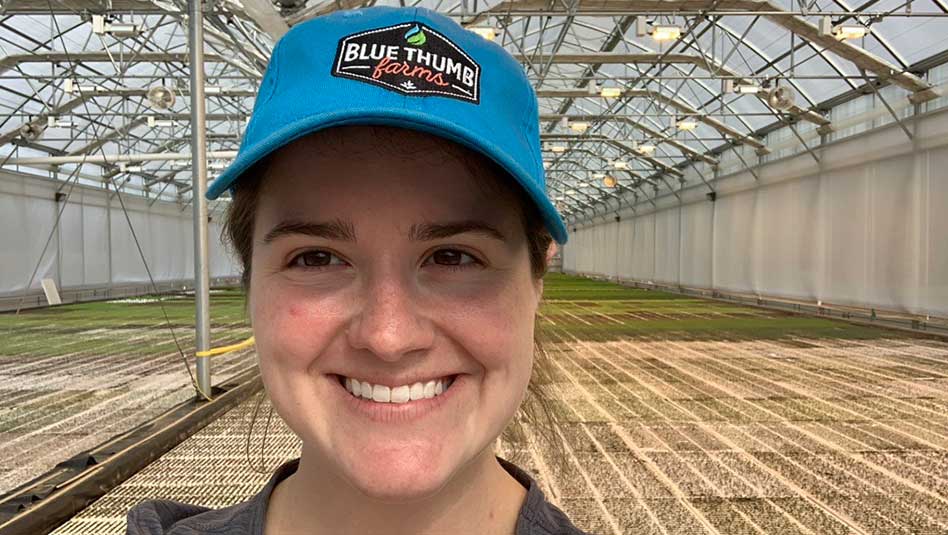
Before her role as key account manager on the Philips Horticulture LED solutions team, Allison Driskill operated a leafy greens business. All photos courtesy of Signify.
Brice has seen how quickly controlled environment agriculture has evolved and has watched as the industry shifted from growing head lettuces to leafy green production to meet consumer demand and preferences. And along the way, Signify has conducted research and case studies to determine the ideal light levels for myriad varieties, whether the grower’s goal is to increase yield, save on energy costs or steer the plant toward a specific color or shape.
“Yields and revenues are higher with the varieties that are being selected and grown. So, I'd argue even if you're farther south, where historically you'd think, ‘I don't need to light this crop,’ there is a really worthwhile case to consider for lighting. Not only on yield increase, because we're using varieties that can accept higher light levels, but you can increase your revenues per year and usually within a two- to three-year time period have a payback on an LED installation without a rebate,” Brice says. “In a lot of cases that I've looked at, if you can put in 20% to 30% more light input per year, that revenue hits your bottom line, and the cost of an installation will pay itself off in a reasonable time frame.”
In conversations with growers producing all crops, including leafy greens, Driskill and Brice always start with examining systems they have in place, their pain points and their goals.
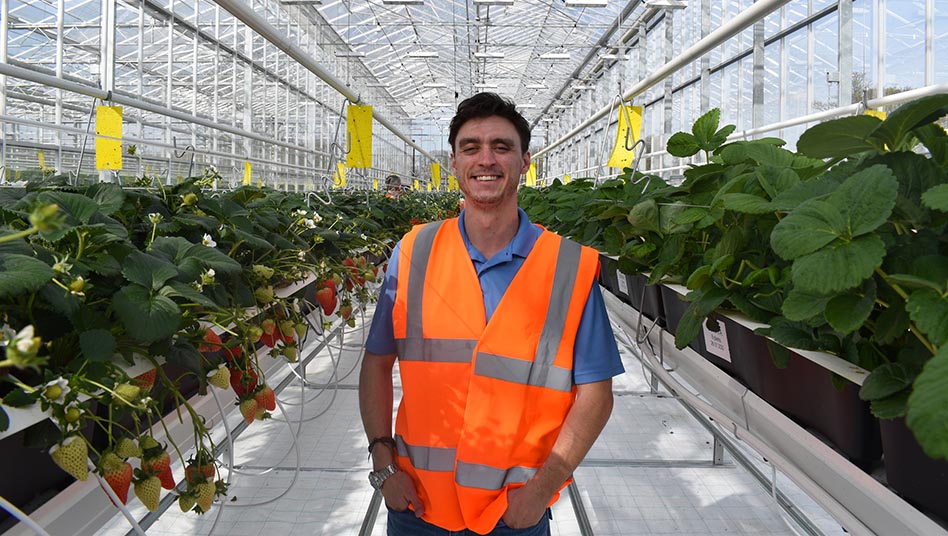 Colin Brice, key account manager with Philips Horticulture LED solutions, owned a microgreens company before joining Signify.
“Every facility and every operation is its own puzzle. I break it into three categories,” Driskill says. “If you've never had lighting before; if you've got lighting, but you're looking at doing a retrofit from HPS fixtures; or if you already have LED lighting and then maybe you want to increase lighting or swap out what you've got.”
Then they dig into questions such as, what are they struggling with? What is the desired outcome? And what’s the best way to get there?
Goal: Increase yield
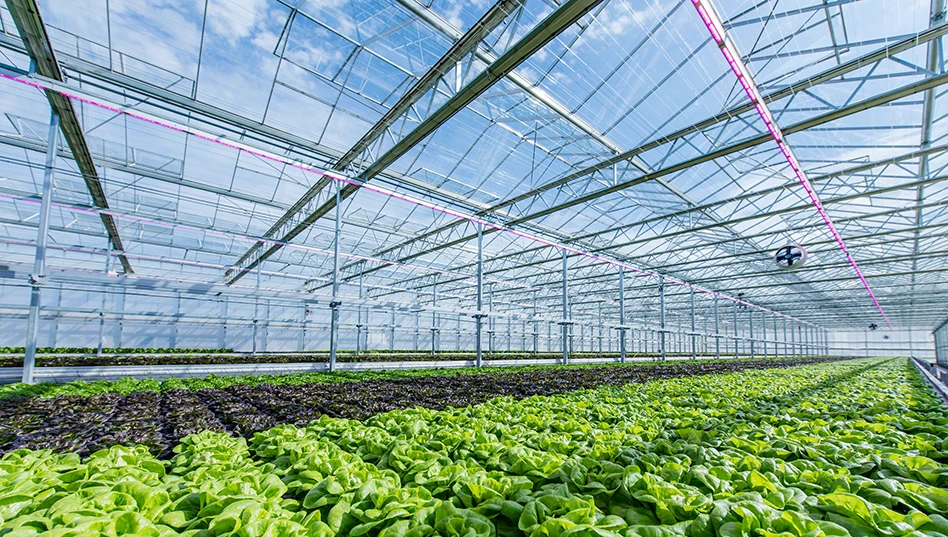
With the cost of expanding high-tech greenhouses, sometimes structural upgrades are not feasible for growers looking to increase production. Adding light strategically can help growers maximize yield in an existing facility without having to increase space and can also help them offset seasonal lighting fluctuations in greenhouses, especially in leafy greens varieties, which can thrive in higher light levels.
“For a greenhouse grower, they need to have consistent, high output for their buyers that's of consistent quality,” Brice says. Adding LED lighting to a facility with HPS or without supplemental lighting can help them achieve those goals. “And they get a price premium (for leafy greens) in the winter oftentimes. When they hear those arguments, they're like, oh, well, of course a lighting person would say that. But the truth is in the numbers, and the devil is in the engineering calculations you do behind this stuff, and that's usually what it proves out. It's worthwhile to look at it.”
Every operation is different, but in general, a 1% increase in light will result in a 1% yield increase, as along as other environmental controls are properly dialed in, Brice says. While head lettuce crops don’t necessarily require more light, leafy greens can get to daily light integral (DLI) ranges on par with light-loving tomato and cucumber crops.
“Head lettuce crops usually take up to 15 to 17 mols per square meter per day, so a DLI of 15 to 17. Whenever you're able to increase from baseline to that, you could expect that 1% increase,” he says. “And for teen leaf, 18 to 22 is a pretty widely accepted and deployed DLI target. But (growers) are pushing the ceiling on this with certain varieties up to 30 mols per square meter per day.”
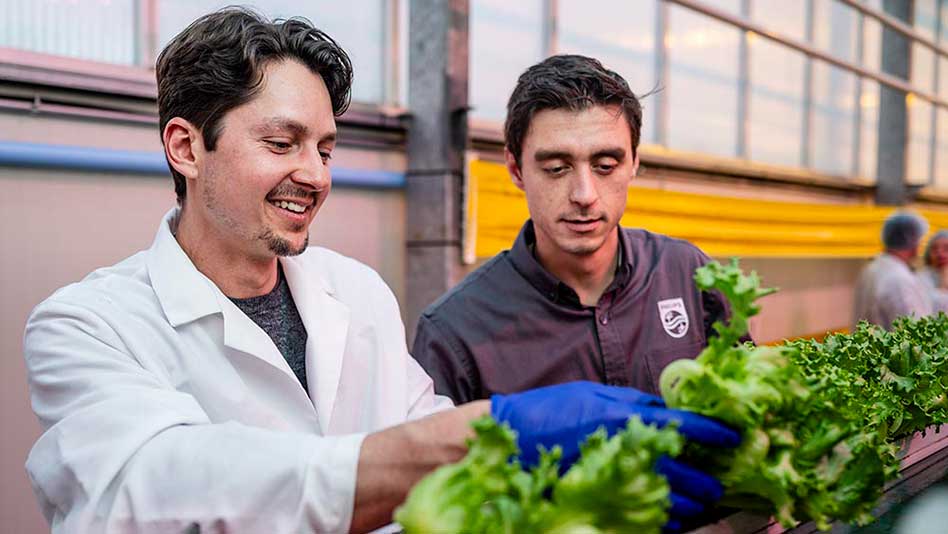 With a background in horticultural sciences and production and owning his own microgreens business, Colin Brice applies his plant expertise when working with customers as a key account manager at Signify.
Often, there are either prescriptive or custom rebates available from energy suppliers that can cover a significant portion of the cost, making a large capital investment like lighting possible.
“If there's a compelling rebate, then you really should be looking at it because those rebates won't be around forever. And then you'll be behind the eight ball when all your neighbors have LED systems, and you don't have the competitive edge in that winter period,” Brice says.
Being as efficient as possible is a goal Driskill often hears as well.
“You want to have as many turns as you can because you want to be able to provide that volume consistently, especially when you're selling into a retail environment,” she says.
Goal: Reduce crop loss
As any grower knows, dealing with live plants involves some risk of loss. One benefit of LEDs is that they emit less heat, so it’s easier to control the environment in hotter climates even when pushing the crop with supplemental light.
“I’ve seen entire greenhouses with lettuce thrown away because it was so hot and humid,” Brice says. “They still had some HPS in the greenhouse. They were using their lights, things were going well in the summer, but then it gets humid and hot, and summers are oppressive. Another quality benefit that's huge is the removal of heat from direct transmission to the plants, especially when we're talking about lettuce crops.
“It's just one other way that the technology can come in and help recuperate lost revenue as well as maximize potential revenue on a production level.”
Goal: Maximize consistency
Consumers don’t necessarily appreciate the effort it takes to grow the same crop the same way every time. What they want is consistency in their bagged lettuce or pints of tomatoes, 52 weeks a year, Driskill says. But that takes sophisticated technology.
“When I walk into the grocery store, I don't want my leafy greens mix to be very different in December than it was in July,” Driskill says. “And that is the challenge of the operator, because as you can imagine, especially in North Carolina, December and July look very different. Same goes for if you're selling to restaurants — you know they have these mixes that they're expecting to look the same year-round. That's what the chef wants. And so you use the tech to have seasonally agnostic crops coming out.”
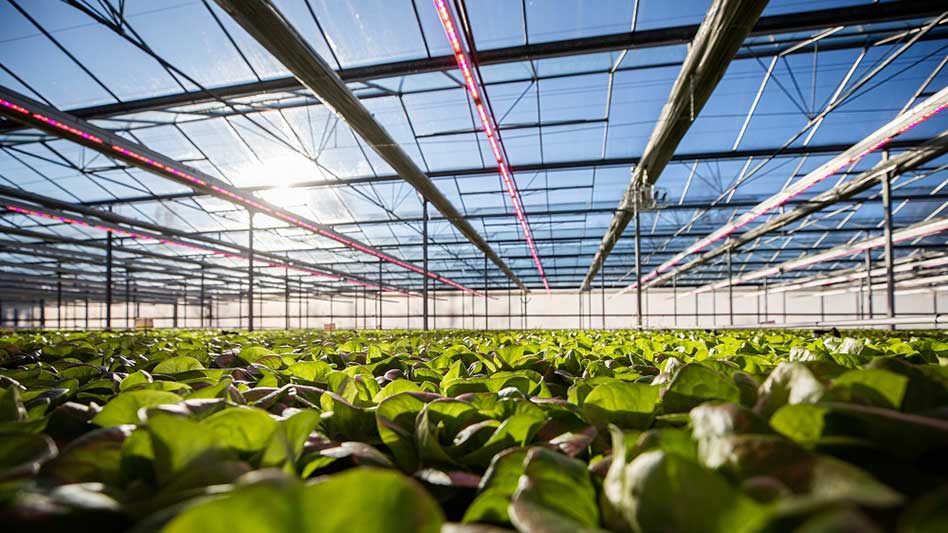 LEDs can help operations achieve peak consistency and efficiency year-round, helping to meet the demand from grocery stores, restaurants and consumers.
Consistency means producing not only the same color and structure of leafy greens, but also the same amount to ensure there is enough produced to meet client demands, whether you have a mostly sunny or stormy July.
“When we start a project with someone, usually one of the first things that we're going to do is ask you questions about your greenhouse and then take the data from the natural light in your region and identify, OK, here are the times of year you are going to see less than ideal light levels to maintain the certain mols of DLI per day that you need to create a quality crop that meets your spec,” Driskill says. “And here's what we need to supplement to make sure that you can maintain that year-round. Having light as a tool allows you to be able to keep that consistency year-round, which will also allow you to keep that quality year-round.”
Goal: Achieve a specific color or leaf architecture
Having the ability to control and steer crops to achieve specific hues and shapes is another goal Driskill often hears from growers.
“LEDs give you spectral control, where you can manipulate your blue light, for example, to keep your crop more compact,” Driskill says. “Or you can manipulate far red and elongate the plant or have your full heads (of lettuce) open up more.”
Brice adds that even if you don’t necessarily need supplemental light, you can use LEDs to extend your photoperiod or keep it more consistent to get those improvements in color and shape.
“Being able to control and put in a couple hours of LED light in the morning and at night are going to help you with maintaining your quality, especially in a head crop but also in a teen leaf crop,” Brice says. “We've conducted many studies to show that’s the case.”
Goal: Reduce energy consumption and costs
Cost is often the chief concern for investing in LEDs. But Driskill says it’s important to factor in not only the capital expense but the operating expense and the return on investment for adding lighting.
“If you can add X amount in lighting, how much yield uplift could you expect? And then how long does it take to pay off?” Driskill says. “If you're talking to someone investigating the retrofit, we ask do you want to increase light and keep the same wattage install? Or do you want to cut your energy bill by 50% and keep the same light levels? And what does that look like for you? Is there a rebate involved that could help pay for this, and does that change the ROI calculation?”
Goal: Start small and ease into LEDs
To benefit from LED systems, an entire facility conversion or retrofit isn’t always necessary. Some growers prefer to start in a single bay, and benefits can be seen even when starting with one stage of plant growth.
As Stefan van de Voort, key account manager for indoor farming for Philips horticulture LED solutions at Signify, noted in the most recent issue of Produce Grower, “We have figured out during our trials using vertical systems in the seedling phase can make a highly energetic seedling that gives a good growth start in the greenhouse, and that can give you extra yield without changing the production setup.”
Signify research has explored the benefits of using lighting in just a single phase of the crop cycle if that’s the best fit for the grower from a cost, energy or facility perspective, Driskill says.
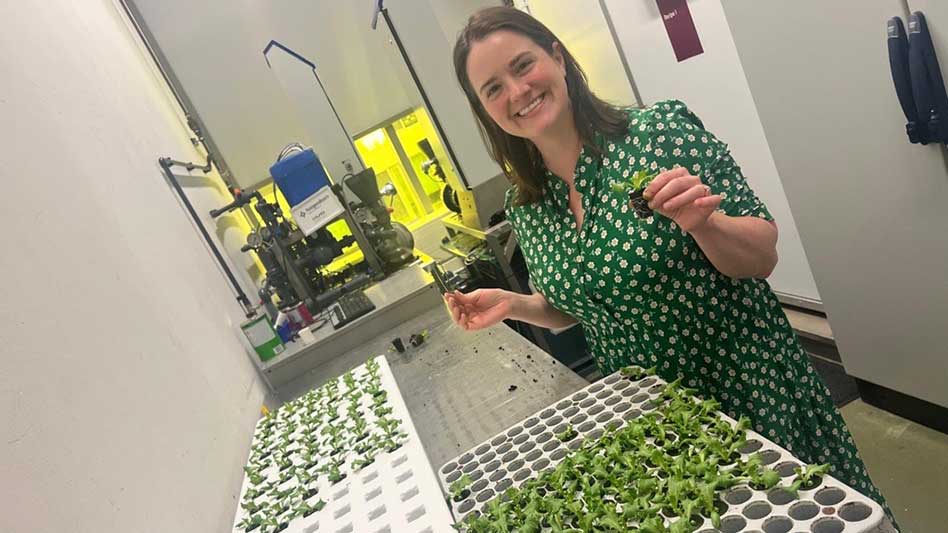 Researchers at Signify are discovering that even adding supplemental lighting in just one phase of a crop, especially when plants are young, can result in higher yields and better quality once plants mature.
“You can put more lighting strategically on the young plant phase of a crop and have it pay dividends at harvest,” she says. “An important calculation that we do is light use efficiency. Not all leafy greens growers grow with sunlight. We have quite a lot of customers that are growing in vertical farms. So, we have a lot of data on how effectively a plant is going to take those photons and convert them into mass. And from that research, we realized that lighting more intensively during the young plant phase ends up resulting in higher yields at harvest, regardless of if you continue that high intensity throughout until harvest.”
Growing vertically and adding tiers can double or triple production space without the need for a facility expansion.
“We've seen a lot of growers looking into that as well as lighting more intensively during that young plant phase because you're lighting more plants in a smaller area,” Driskill says. “It can be a really strong investment to just increase your lighting over that phase.”
Goal: Work with an LED provider where support and resources are available
Like Driskill and Brice, many people on the Signify team are former growers or have horticultural backgrounds and can offer support based on real-word experiences and results-driven research.
Research and case studies have been a focus for Philips since the beginning, when in 2006, the company began working with growers and universities to better understand crop-light interactions, which led to its advancements and developments in LED technology.
“We base everything around the grower. With every project, you must have three points of contact that are supporting you,” Driskill says. “There's the key account manager, like Colin and me. We’re going to be the people who you are directly connected with, and we're really figuring out where your pain points are, what's going to be best for your project.”
Then, there are application engineers who help with installation and assist with commissioning any existing control systems.
And lastly is the plant specialist team, which Driskill says growers often find the most valuable.
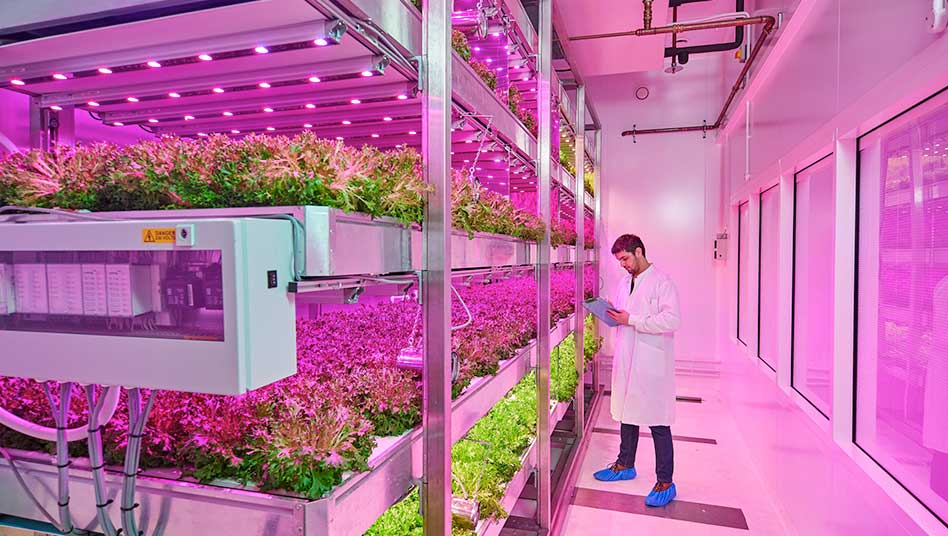 At the Philips GrowWise Research Center in the Netherlands, the team continues to conduct trials to keep enhancing their LED products and recommendations to growers.
“We have dedicated plant specialists who are going to advise based on your crop, your situation, what your goals are for your team and say, ‘OK, here's the light level that we want to find, the uniformity of light that we need to find.’ Our plant specialists of course advise on light, but they understand that everything is holistic. So, lighting is not in a vacuum. You have to have your climate dialed in as well. These are real experts that come in and can help advise even if you're making the switch from HPS to LED and what it means when you remove that heat.”
At the Philips GrowWise Research Center in the Netherlands, the team continues to conduct trials to keep enhancing their LED products and recommendations to growers.
“We're doing trials in eight different climate chambers on all different types of crops,” Driskill says. “Van de Voort just finished many trials on Finstar, which is one of the top teen leaf varieties grown in the U.S., and we're taking that knowledge and spreading it out to our customers to say, ‘Hey, here's some trials that we recently did on lighting high intensity for young plants in Finstar.’ We're constantly researching on our own, taking what we're learning and then using that to benefit growers.”