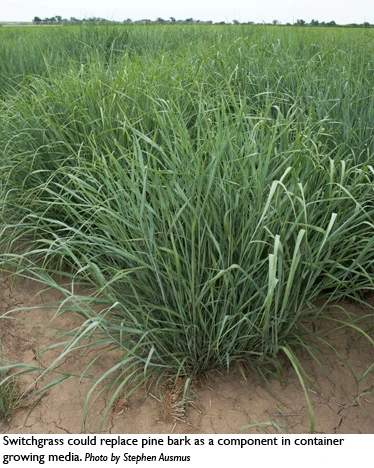
Switchgrass could provide the horticulture industry with a viable growing media component. USDA adjunct scientists at Ohio St. University’s-Ohio Agricultural Research and Development Center have found that switchgrass can replace pine bark in the production of container crops. Combined with several amendments such as peat moss and compost, the mix could be used to produce herbaceous perennials, roses and other woody shrubs.
The study, “Use of Switchgrass as a Nursery Container Substrate,” has been published in a recent issue of the journal HortScience. The research was conducted in response to concerns to the price increase and decrease in availability of pine bark.
James Altland, a USDA-Agricultural Research Service research horticulturist said the current economic crisis and increase in energy prices is causing paper mills and lumber mills to use pine bark to fuel their own facilities rather than selling it as a byproduct. He said that the demand for forest products has also decreased so that pine bark is not as readily available. Altland said switchgrass was chosen as an alternative media component because of its high biomass potential and the possibility of establishing a production system that could link the farming and nursery industries in locally producing and processing a high-value crop.
While the infrastructure is not yet in place, Altland envisions a system that allows the nursery industry to contract with a farmer to grow switchgrass and then process it to grind it to the desired potting mixture consistency. Potentially up to 5 tons of switchgrass can be produced per acre, producing 50 cubic yards of switchgrass substrate mix per acre. About 2,800 acres would be needed to produce the growing mix the Ohio nursery industry would require each year.
Altland estimates it would cost farmers about $5-$6 per cubic yard to grow switchgrass compared to $4 a cubic yard for corn stover, which is also being reviewed as a potential container substrate.
Atland also said that researchers are also hoping that wheat straw, another biomass crop that is already available, could be used as a media component.
“There isn’t a big market for wheat straw itself, so farmers may just bale some of it up or till it under,” he said. “With 800,000 acres of wheat planted this year, we hope that our research proves that wheat straw can also be a viable nursery container substrate.”
Latest from Greenhouse Management
- The Growth Industry Episode 10: State of the Horticulture Industry
- Millennium Pacific Greenhouses launches California Grown Cucumber Program
- Scientists develop vitamin A-enriched tomato to fight global deficiency
- Tennessee Green Industry Field Day scheduled for June 11
- UTIA and UT Knoxville research teams will develop automated compost monitoring system
- Ken and Deena Altman receive American Floral Endowment Ambassador Award
- [SNEAK PEEK] Leading Women of Horticulture: The women of Fairview Greenhouses & Garden Center
- [SNEAK PEEK] Leading Women of Horticulture: The inventive women of TPIE ’26