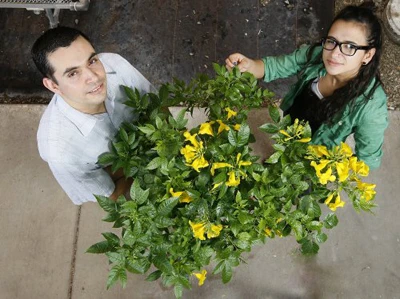
Purdue Univ. horticulture professor Roberto Lopez and doctoral student Arianna Torres have developed a set of propagation and production protocols for Tecoma stans. The shrub, which produces yellow trumpet-like flowers, is native to Central and South America. The two researchers have determined the optimal light intensity, temperature and photoperiod for the plant.
“It’s an energy-intensive crop because it needs supplemental light and warm temperatures, but it can be a profitable crop for growers,” Lopez said.
T. stans is not a target of most pests found in Indiana and it is drought-tolerant. Although it is a perennial in its native environment, the plant won’t survive Indiana winters. Lopez said the plant potentially could be overwintered indoors, but it would likely be grown as an annual in Indiana that could be potted or planted in a flowerbed for one season.
Lopez and Torres are developing an extension bulletin that will provide commercial growers with detailed cultural specifications for producing and flowering the plant.
Pictured: Purdue Univ. horticulture professor Roberto Lopez and doctoral student Ariana Torres developed production protocols for Tecoma stans, a tropical flowering shrub.
Photo by Tom Campbell, Purdue Agricultural Communication
Latest from Greenhouse Management
- Jackson & Perkins expands into Canadian market
- Green & Growin’ 26 brings together North Carolina’s green industry for education, connection and growth
- Marion Ag Service announces return of Doug Grott as chief operating officer
- Cincinnati Zoo & Botanical Garden debuting new perennial section at 2026 Breeder Showcase
- The Garden Conservancy hosting Open Days 2026
- Registration open for 2026 Perennial Plant Association National Symposium
- Resource Innovation Institute and North Dakota State University explore co-location of data center and greenhouses
- Fred C. Gloeckner Foundation Research Fund calls for 2026 research proposals