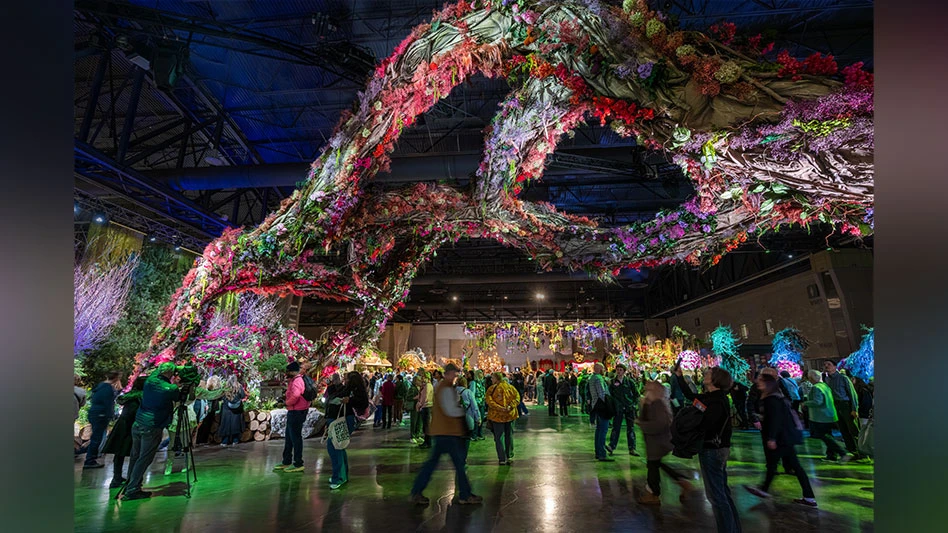
Plants represent a major part of the sustainability movement. All facets of the horticulture industry, from growers to retailers and landscape architects to consumers, need to understand how plants fit into the “green” picture.
“The significance in producing sustainable, low-maintenance crops at the grower level is relevant at the retail level as well,” said Ed Overdevest, president of Overdevest Nurseries in Bridgeton, N.J. “Nationwide, homeowners are seeking outstanding varieties that perform well in their landscapes, and are becoming more curious to know if they are produced in the same eco-friendly manner they’ve come to expect from other home and garden products they purchase for their families.”
Water-conserving plants, including drought-tolerant selections, natives and desert succulents, make up a sustainable landscape and are catching the eyes of more consumers.
Coreopsis ‘Pinwheel’ from Overdevest Nurseries’ Garden Splendor brand is a low-water-use plant. It’s a full-sun perennial hardy to USDA Hardiness Zone 6. Salvia ‘Sensation Rose’ from Novalis is a drought-tolerant selection that flowers from early summer through fall. It’s hardy to Zone 8.
When drought hits a region, landscape watering is often targeted with municipal restrictions. There are a multitude of drought-tolerant plants to grow and sell, from perennials and groundcovers to trees and shrubs.
Drought-tolerant perennials include Aster spp., Rudbeckia hirta, Geranium spp. and Baptisia australis, said Gordon Johnson, extension agent at
On the drier side
Wade Roitsch, nursery manager at YuccaDo Nursery in
“People say water is the next oil, and water is becoming so precious that more people are considering dry-loving plants and desert succulents,” Roitsch said. “Our niche is the new and unusual species in that category.”
Production costs of desert succulents are about the same and sometimes less expensive than typical nursery stock, he said. And propagation techniques have improved to include agaves from tissue culture and better seed selection.
EuroAmerican Propagators’ RetroSucculents line offers16 varieties, but will increase to 45 by the 2008-2009 season. Agave celsii ‘Nova,’ Aloe x ‘Pink Blush’ and Echeveria subrigida ‘Fire and Ice’ are a few of the durable and low-water-use plants that grow well in the landscape, in containers or as houseplants.
Finish times for ‘Nova’ are five months from a plug to a 4-inch pot or 4-inch to a 1-gallon; and six months from a 1-gallon to a 2-gallon. Finish times for ‘Pink Blush’ and ‘Fire and Ice’ are five months from a plug to a 4-inch container and five months from a 4-inch to a 1-gallon.
Creating a plan
Growing and marketing water-conserving plants is a good green step, but a new industry group wants to craft a more comprehensive plan for sustainable landscapes.
The Sustainable Sites Initiative (SSI) is a new effort to develop standards and guidelines for site development that will reduce the environmental impact of landscapes. SSI members include American Society of Landscape Architects,
The standards are intended for use by designers, architects, contractors, engineers, developers, builders, maintenance crews, horticulturists and governments.
“The standards are an important tool for the nursery industry,” said Heather Venhaus, SSI project manager and environmental designer at
SSI intends to supplement existing green building standards and rating systems and has the potential to serve as stand-alone guidelines for creating Sustainable Sites. The U.S. Green Building Council has pledged to include Sustainable Sites in future versions of their LEED (Leadership in Energy and Environmental Design) Green Building Rating System.
The initiative may help tie the landscape to the beginning of the building design process, instead of being an afterthought once the bulk of a project budget has already been spent, said Bob Dolibois, ANLA executive vice president.
SSI plans to release two interim reports before a final document is due in spring 2009.
The guidelines will be used to construct a ranking system (due spring 2011) with specific site-performance goals. These ratings will recognize performance in achieving a sustainable site. Credits will be assigned for meeting performance goals so that each site can be rated. A reference guide is due by spring 2012. It will be a user guide describing how various pilot projects achieved sustainability goals.
For more: Overdevest Nurseries, (888) 842-6567; www.overdevestnurseries.com. Novalis, (888) 845-1988; www.novalis.com. Gordon Johnson,
- Kelli Rodda
{tab=X-rated}
Water-conserving plants
The term “sustainable” is being bounced around more than any other buzzword of this decade. But sustainability is no fad. It’s not a pipe dream. Every industry is jumping to find its slice of the green pie and market its sustainability products or practices to consumers.
Horticulture is the real green industry -- the original. But we can’t rest on our laurels. We must tout our products as sustainable and live by example. That means saving water and energy.
Water conservation affects every region in the country, whether there’s a drought or not. Growing and marketing water-conserving plants is an excellent and easy way to take advantage of the green movement.
Garden Centers of Colorado created a superior marketing campaign for plants that thrive in dry conditions. “Get X-Rated: Xeriscape Gardening” rates plants as X-rated, XX-rated and XXX-rated. Plants with one X thrive in slightly dry conditions; XX plants thrive in dry conditions; and XXX plants thrive in very dry conditions. It’s an easy-to-follow and exciting campaign.
{sidebar id=2}
X-rated plants include linden, forsythia and foxglove. Pines, butterfly bush and daylilies fall in the XX-rated category. The heavyweights of the xeriscape varieties include bigtooth maple, sumac and penstemon.
For more: www.xratedgardening.com.
{tab=Green Perspective}
The time is now to go green
As we move into 2008 we look back over the previous year and can see it was the year “green” moved from a minor niche to become a significant and growing segment of the marketplace.
Today there is significant increase in awareness of environmental issues. Al Gore was awarded the Nobel Prize for focusing public attention on global warming. And as a result there are signs of changes emerging in purchasing behavior.
In October 2007
Now it’s cool to do the right thing for the environment and for business. And the good news is the nursery industry is well-positioned to capitalize on this trend. At one level, we’re already green. Green is the color of leaves and photosynthesis; we help our customers use their green thumbs, and along the way we earn green dollars.
We can easily take advantage of the natural biological cycle to compost a lot of the waste material in our business, but there is a lot more we need to do if we are to achieve success in the 3 Es of sustainability: economic, environmental and (social) equity.
Throughout the year, we’ll dig a little deeper into individual examples and highlight areas where you can make a difference with positive benefits to the environment and to your business.
{sidebar id=2}
- Ken Alston
Ken Alston is CEO of the environmental consulting firm MBDC, http://mbdc.com, and is the owner of Commonwealth Plants LLC., http://japanese-maple.com.
{tab=Green Regions}
The Grow Native! is a joint program between Missouri Department of Conservation (MDC) and Missouri Department of Agriculture (MDA). The program was designed to increase conservation awareness of native plants and their effective use.
MDA houses Grow Native! marketing and business development services for member businesses that supply native plants, seeds and related services such as design, installation and maintenance. Together, MDC’s and MDA’s efforts make it easy for everyone to discover, buy and successfully use
The program includes usage rights of the Grow Native! logo, point-of-purchase material and tags.
Devin Chandler, owner of Prairie Hill Farm in
“Our sales have really taken off since becoming part of this program,”
Growing natives is certainly part of the green movement, but it’s not without challenges.
“Some wildflower seed has a stratification time of two to four months and some have poor germination rates,”
{sidebar id=2}
He’s constantly tweaking production.
For more: Grow Native!, (573) 522-4171; www.grownative.org. Devin Chandler, Prairie Hill Farm, (573) 387-4680; chandler@ktis.net.
{tab=Glossary}
Carbon footprint: A representation of the effect human activities have on the climate in terms of the total amount of greenhouse gases produced (measured in units of carbon dioxide).
Integrated pest management (IPM): An ecologically based approach to pest control using a multi-disciplinary knowledge of crop/pest relationships, establishment of acceptable economic thresholds for pest populations and constant monitoring for potential problems.
{sidebar id=2}
Sustainable development: Meeting the needs of the present without compromising the ability of future generations to meet their own needs.
Source: USDA’s
{/tabs}
Latest from Greenhouse Management
- The Growth Industry Episode 10: State of the Horticulture Industry
- Millennium Pacific Greenhouses launches California Grown Cucumber Program
- Scientists develop vitamin A-enriched tomato to fight global deficiency
- Tennessee Green Industry Field Day scheduled for June 11
- UTIA and UT Knoxville research teams will develop automated compost monitoring system
- Ken and Deena Altman receive American Floral Endowment Ambassador Award
- [SNEAK PEEK] Leading Women of Horticulture: The women of Fairview Greenhouses & Garden Center
- [SNEAK PEEK] Leading Women of Horticulture: The inventive women of TPIE ’26