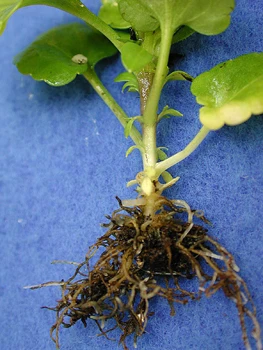
The fungus Thielaviopsis causes black root rot on pansies, petunias and vinca. It may also infect begonia, cyclamen, impatiens, nicotiana, phlox, poinsettia, primula, snapdragon and verbena. Mich. St. Univ. plant pathologist Mary Hausbeck and research assistant Blair Harlan said symptoms of black root rot often mimic nutrient deficiencies such as stunting and shriveling of older leaves. Leaves may turn yellow and the youngest leaves become stunted and tinged with red. In mild infections, older leaves are yellow-green with the veins retaining their green color. Black root rot may also affect the lower stems on crops such as poinsettia, causing cracks that appear black.
Sanitation is the best preventive measure against black root rot. Once this fungus is established in a crop or in a greenhouse, an effective fungicide program is needed.
In an evaluation trial of fungicides to control Thielaviopsis root rot on pansy only two treatments (experimental BAS 595 16F and OHP 6672 4.5L) completely prevented plant death.
Pictured: Black root rot caused by the fungus Thielaviopsis is a serious threat to pansies.
Photo by Margery Daughtrey, Cornell Univ.
Latest from Greenhouse Management
- Jackson & Perkins expands into Canadian market
- Green & Growin’ 26 brings together North Carolina’s green industry for education, connection and growth
- Marion Ag Service announces return of Doug Grott as chief operating officer
- Cincinnati Zoo & Botanical Garden debuting new perennial section at 2026 Breeder Showcase
- The Garden Conservancy hosting Open Days 2026
- Registration open for 2026 Perennial Plant Association National Symposium
- Resource Innovation Institute and North Dakota State University explore co-location of data center and greenhouses
- Fred C. Gloeckner Foundation Research Fund calls for 2026 research proposals