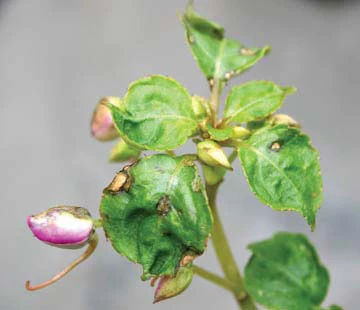
As the weather warms up Univ. of Md. Extension officials advise growers to monitor crops closely for thrips populations. Crops that should receive close attention include impatiens, New Guinea impatiens, begonias, snapdragons, cyclamen, cineraria and gloxinia. These plants are susceptible to impatiens necrotic spot virus (INSV), which is vectored by western flower thrips. INSV is a tospovirus, which causes a variety of symptoms, including black or brown areas on stems, stunting, yellow mottling and white or dark ring spots on leaves.
Thrips tend to hide in tight spots such as flower buds. Using a tap test dislodges thrips from the plants so it can be determined if thrips are present and in what numbers.
Make sure to examine incoming plants for INSV symptoms and thrips. Keeping the virus and thrips out of the greenhouse is the best management strategy. There is no cure for infected plants. They must be discarded.
Pictured: Impatiens necrotic spot virus symptoms on impatiens.
Photo courtesy of Univ. of Md. Extension
Latest from Greenhouse Management
- The Growth Industry Episode 10: State of the Horticulture Industry
- Millennium Pacific Greenhouses launches California Grown Cucumber Program
- Scientists develop vitamin A-enriched tomato to fight global deficiency
- Tennessee Green Industry Field Day scheduled for June 11
- UTIA and UT Knoxville research teams will develop automated compost monitoring system
- Ken and Deena Altman receive American Floral Endowment Ambassador Award
- [SNEAK PEEK] Leading Women of Horticulture: The women of Fairview Greenhouses & Garden Center
- [SNEAK PEEK] Leading Women of Horticulture: The inventive women of TPIE ’26