If your spring plants appear to be ahead of schedule, you may be thinking about applying a growth regulator. Univ. of Mass. extension floriculture specialist Tina Smith and Univ. of Conn. extension horticulture and greenhouse IPM specialist Leanne Pundt said the proper growth regulator rate should provide enough control to hold mature plants under hot weather for 2-3 weeks, but low enough that plants recover and grow for consumers. Spray treatments carry less of a risk of overdose than drench treatments, especially when root-active growth regulators are applied.
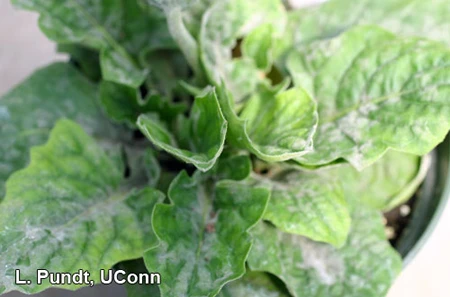
Growers of gerbera should be monitoring for powdery mildew. When the weather turns cloudy and rainy, avoid wet foliage, reduce humidity by heating and venting and monitor for Botrytis.
Spider mites are very successful at surviving over the winter in their resting stage. They can hibernate in greenhouse crevices. Growers who encountered problems with mites last year are likely to have problems again this year.
Ivy geraniums, mandevilla and perennials such as salvia, monarda, nepeta and perovskia are prone to spider mites. Spider mite injury on ivy geraniums looks like oedema, so plants should be carefully monitored with a hand-lens.
Pictured: Powdery mildew on gerbera. Photo by Leanne Pundt, Univ. of Conn.
Latest from Greenhouse Management
- The Growth Industry Episode 10: State of the Horticulture Industry
- Millennium Pacific Greenhouses launches California Grown Cucumber Program
- Scientists develop vitamin A-enriched tomato to fight global deficiency
- Tennessee Green Industry Field Day scheduled for June 11
- UTIA and UT Knoxville research teams will develop automated compost monitoring system
- Ken and Deena Altman receive American Floral Endowment Ambassador Award
- [SNEAK PEEK] Leading Women of Horticulture: The women of Fairview Greenhouses & Garden Center
- [SNEAK PEEK] Leading Women of Horticulture: The inventive women of TPIE ’26